Black and white house icon with roof, chimney, and round window.

What to Do After a Hail Storm in North Texas: A Step-by-Step Guide for Homeowners

April 21, 2026

The storm has passed. You're looking out at your yard — dented gutters, maybe a cracked window, hail still melting on the driveway — and you're wondering what to do next. The decisions you make in the first few hours after a North Texas hail event have a direct impact on your insurance claim outcome, how much damage compounds before repairs begin, and whether you end up hiring a qualified local roofer or a storm chaser who'll be gone before the problems they missed show up in your ceiling. Swift Roofing has helped Rockwall and Royse City homeowners navigate post-hail recovery through some of North Texas's most significant storm seasons. This is the step-by-step guide we'd walk you through on the phone.

What to Do in the First Hour After a North Texas Hail Storm

The first hour after a hail storm is the most important — and the most commonly mishandled. Here's the correct sequence:


First 30 minutes — safety before assessment:


  • Check that everyone is safe and look for downed power lines, broken glass, and structural hazards before going outside
  • Stay off the roof — wet surfaces, hidden structural damage, and debris make post-storm roof access genuinely dangerous
  • Address immediate water intrusion — if water is entering the home, set up buckets and cover broken windows with plastic or plywood if it's safe to do so
  • Check utilities — if you smell gas or notice electrical issues, shut off utilities and leave the area


First hour — documentation before anything else:


  • Photograph and video everything before touching anything — exterior of the home, roofline, gutters, siding, windows, vehicles, and any hail still on the ground. Use a ruler or coin next to hail for size reference
  • Do not throw away damaged items — every damaged shingle, screen, and belonging is evidence for your insurance claim
  • Document the surrounding area — dented mailbox, damaged AC unit, broken tree branches. These establish storm severity for your claim


Immediate action steps:


  • Contact your insurance company to report the loss and get a claim number — North Texas adjusters book up quickly after major hail events, and earlier reporting gets you earlier in the queue
  • Call Swift Roofing for a professional inspection before the adjuster arrives — this is one of the most important steps most homeowners skip
  • Save all receipts for any emergency materials — tarps, plywood, temporary repairs are typically reimbursable under your policy

How to Check Your Roof for Hail Damage From the Ground

Do not get on your roof to inspect it yourself — the risk isn't worth it and a trained inspector will find damage you'd miss anyway. Here's what a careful ground-level assessment looks like:


Check soft metal components first — they tell the story fastest: Aluminum roof vents, metal flashing, chimney caps, and gutters dent visibly when struck by significant hail. Dents in these components are the clearest ground-level signal that hail impact was strong enough to affect roofing materials too.


Check gutters and downspouts: Granule accumulation in gutters indicates hail has stripped the protective coating from asphalt shingles. This is one of the most important ground-level signals — granules in gutters means the shingles above have been compromised even if they appear intact from the street.


Check siding, windows, and window screens: Dents in siding, splintered wooden trim, or broken screens establish that hail velocity was high enough to cause impact damage. If these elements show damage, the roof almost certainly does too.


Use binoculars on the roofline: Look for missing, lifted, or curled shingles. Look for dark circular spots — these are the "bruises" where hail has displaced granules and damaged the shingle mat beneath. Look for any areas where the dark asphalt backing is exposed.


Check surrounding property: Dented mailbox, patio cover, outdoor AC unit — these corroborate storm severity for your insurance claim and help establish the damage was storm-related, not pre-existing.


Damage indicators by material:


  • Asphalt shingles — dark circular bruised spots, granule displacement, lifted edges
  • Metal roofing — dents, scratches, lifted panel edges
  • Tile roofing — cracks, chips, or broken sections


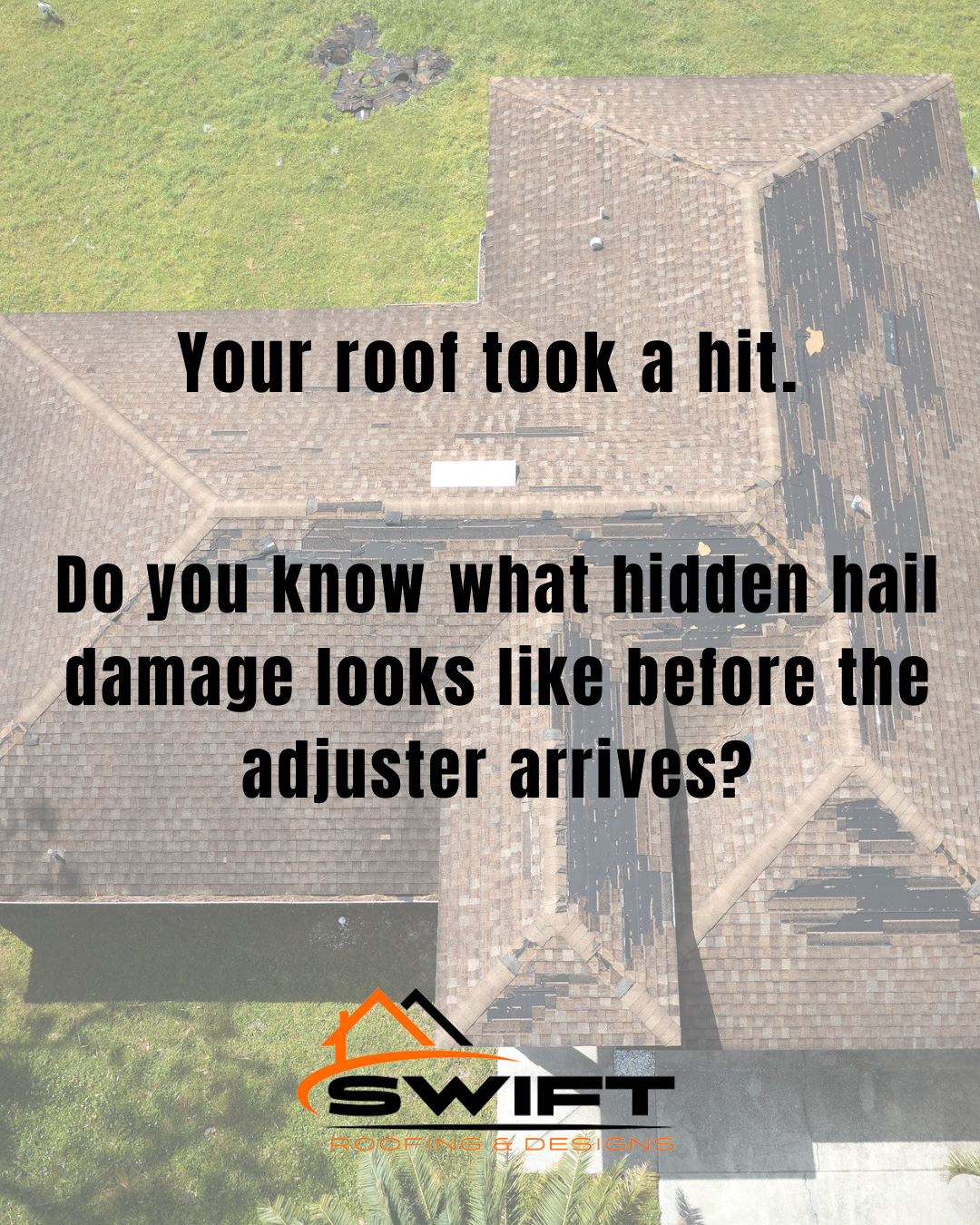
Signs of Hidden Hail Damage You Can't See From the Ground This is the part that catches Rockwall and Royse City homeowners off guard — and the reason a professional inspection matters even when your roof looks relatively intact from the street.


Granule loss and bald spots Hail strips the protective granule coating that shields asphalt from UV radiation. The granules in your gutters are gone from your shingles — and the exposed asphalt beneath begins degrading immediately. From the ground this looks like subtle discoloration. Under professional inspection it's measurable, documentable damage.


Bruised shingle mats Similar to a bruised apple — the surface may look intact but the mat beneath is crushed. This is the most commonly missed and most consequential form of hail damage. Bruised mats lose structural integrity, and the damage progresses into active leaking weeks or months later when water finds the weakened spots.


Broken seal strips Hail impact breaks the adhesive bond between shingles. They appear flat and intact from the ground — but they're no longer sealed. Wind-driven rain events after the hail storm find every gap, and the damage compounds invisibly until it shows up in your ceiling.


Why ground-level inspection isn't enough:

Hidden Damage Type Why It Matters
Structural micro-fractures Invisible to the naked eye — only identifiable through professional hands-on inspection
Compressed insulation boards Structural damage beneath the shingle layer that doesn't appear as surface damage
Delayed leak development Hidden damage often takes 30 to 90 days to manifest as active leaking — by which point mold and structural damage are already progressing
Insurance claim deadlines Most Texas policies require damage reporting within a reasonable time — delayed professional documentation can compromise your claim

What to Do — and What NOT to Do — Before the Insurance Adjuster Arrives

The actions you take between the storm and the adjuster's visit directly affect your claim outcome:


✅ What to do:


Document everything comprehensively Photos and video from multiple angles — close-ups and wide shots that show context. Every damaged surface, every damaged item, before anything is moved or cleaned. The more thorough your documentation, the stronger your claim position.


Make temporary repairs to prevent further damage Your policy likely requires you to mitigate further damage. Tarp damaged roof sections, board broken windows, and address active water intrusion. Keep every receipt — these emergency repair costs are typically reimbursable.


Schedule a Swift Roofing inspection before the adjuster visit Having our inspector present when the adjuster arrives is one of the most valuable steps you can take. We document damage in the specific technical language adjusters use, identify hidden damage adjusters may miss, and ensure all storm-related damage is captured in the initial scope of work.


Have your policy documents ready Policy number, deductible amount, and any previous claim documentation — have these accessible before the adjuster arrives.


❌ What NOT to do:

Don't Why It Matters
Don't discard damaged items Every damaged shingle, screen, and belonging is evidence — don't remove it before documentation
Don't start permanent repairs Replacing roofing or fixing structural damage before the adjuster inspection can void parts of your claim
Don't sign anything immediately Don't feel pressured to sign a final settlement or release of liability before you've had an independent assessment
Don't let contractors inspect alone Never allow an unknown contractor unsupervised access to your roof — damage can be fabricated to manufacture work
Don't over-speculate with the adjuster Answer questions honestly and directly — avoid guessing about cause or estimating costs yourself

How to File a Hail Damage Insurance Claim in Texas

Here's the step-by-step Texas claim process:


Step 1 — Document immediately Comprehensive photos and video of all damaged areas before any cleanup begins. Establish storm date and severity with weather reports if possible.


Step 2 — Contact your insurer promptly Texas policies typically require reporting within a "reasonable time" — generally 3 to 7 days. Report immediately, get a claim number, and ask for your assigned adjuster's name and contact information.


Step 3 — Prevent further damage Tarp, board up, and address water intrusion. Keep all receipts — these are submitted for reimbursement as part of the claim.


Step 4 — Get a Swift Roofing independent inspection before the adjuster arrives This is the step most homeowners skip — and the one that most frequently affects claim outcomes. An independent inspection by Swift Roofing gives you a complete, documented damage assessment that you bring to the adjuster visit rather than relying entirely on the insurance company's evaluation.


Step 5 — Be present for the adjuster inspection — with your contractor Walk the adjuster through every area of damage you and Swift Roofing have identified. Your contractor can communicate damage in technical terms the adjuster recognizes and document in real time what's being observed.


Step 6 — Review the settlement against your independent estimate The adjuster's scope of work and your Swift Roofing estimate should align. If the adjuster's estimate is significantly lower — you have grounds to negotiate based on documented professional assessment.


Step 7 — Finalize repairs with your documentation in order Once approved, proceed with repairs. If a depreciation holdback is issued — Swift Roofing provides completion documentation to release the final payment.

Why Storm Chasers Are a Problem After North Texas Hail Events

Within hours of a major North Texas hail event, door-knockers appear throughout Rockwall and Royse City offering free inspections and guaranteed roof replacements. Here's why this creates serious risk for homeowners:


What storm chasers do:


  • Use inexperienced labor and lower-quality materials to maximize margin on high-volume post-storm work
  • Request full or majority upfront payment — often disappearing before issues surface
  • Use high-pressure tactics to get contract signatures before you've had time to verify credentials or consult your insurance company
  • May request to manage your insurance claim directly — a significant red flag that removes your control from the process
  • Provide no local accountability — when problems appear months later, they're unreachable


How to protect yourself:

Red Flag What It Signals
No enforceable protection if work is substandard Storm chaser pattern — not how reputable local companies generate business
Out-of-state license plates or address No local accountability after the job
Full payment demanded upfront Financial risk — standard professional practice is deposit, materials delivery, completion
"We'll handle your insurance claim" Never surrender control of your insurance claim to a contractor
No written contract with itemized scope No enforceable protection if work is substandard

Verify Texas licensing, confirm a physical local address, request a Certificate of Insurance sent directly from the carrier, and check recent local reviews before signing anything.

How Swift Roofing Documents Hail Damage for Your Insurance Claim

Having Swift Roofing inspect your property before the adjuster arrives changes the dynamic of your claim in a measurable way. Here's specifically what we bring:


Test square methodology We use the industry-standard test square process — documenting hail hit density across 100-square-foot sections of each roof slope. This gives adjusters the quantified evidence required to justify full replacement rather than spot repair.


Comprehensive photo and video documentation High-resolution, time-stamped images of every damaged component — shingles, flashing, vents, gutters, and siding. Before-and-after documentation protocol that separates storm damage from pre-existing conditions.


Written line-item estimate A detailed repair estimate in the same format adjusters use — which reduces scope discrepancies and minimizes the back-and-forth that delays claim resolution.


On-site adjuster presence When our inspector is present during the adjuster's visit, damage gets documented in real time with technical context the adjuster recognizes. This prevents the omission of hidden damage that a homeowner walking alone with an adjuster might not know to point out.


Local code compliance documentation As a locally licensed Texas contractor, Swift Roofing ensures all documentation reflects current local building codes — which matters for full reimbursement on code-required upgrades.

Schedule Your Post-Storm Inspection With Swift Roofing

After a North Texas hail event, the clock is running — on your insurance claim deadline, on hidden damage that compounds without remediation, and on scheduling availability as every homeowner in Rockwall and Royse City tries to get their roof assessed simultaneously.


Swift Roofing prioritizes post-storm inspection requests from Rockwall, Royse City, and surrounding North Texas communities. Our inspectors document damage the way adjusters evaluate it — giving you the strongest possible foundation for your insurance claim from the first conversation.


Here's what every Swift Roofing post-storm inspection includes:

Inspection Component What It Means for You
Comprehensive damage documentation Photos, video, and written report ready before your adjuster arrives
Test square hail density assessment Industry-standard methodology that justifies full replacement vs. spot repair
Hidden damage identification Bruised mats, broken seal strips, and granule loss that ground-level inspection misses
Line-item repair estimate Formatted to align with adjuster scope — reduces claim disputes
Adjuster accompaniment Our inspector present at the adjuster visit to ensure all damage is captured
Storm chaser protection A local licensed contractor on your side from day one
Free inspection No cost to Rockwall and Royse City homeowners

Request a Roofing Quote

Blog Form


More Posts Like This:

Dirty backyard and many leaves on the ground
April 16, 2026
North Texas summer heat is one of the biggest threats to your roof's longevity. Swift Roofing explains what heat does to your roof and how Rockwall homeowners can protect it.
An aerial view of a house with a dark brown shingled roof, an attached white carport, a driveway, and surrounding trees.
April 8, 2026
How long does your roof actually last in North Texas? Swift Roofing breaks down lifespans for asphalt, metal, and tile — and what shortens them faster in Rockwall and Royse City.
A person wearing a high-visibility vest installs new shingles along the ridge of a brown asphalt shingled roof.
April 1, 2026
North Texas weather demands the right roofing materials. Swift Roofing breaks down asphalt, metal, and tile options for Rockwall and Royse City homeowners replacing their roof.
Show More
Black outline of a house with a slanted roof and chimney.

Choose Swift Roofing & Designs for Top Quality Roofing

Need a reliable roofer? We've helped countless clients protect their homes while saving time and money, and we’re ready to help you next.

Dirty backyard and many leaves on the ground
April 16, 2026
North Texas summer heat is one of the biggest threats to your roof's longevity. Swift Roofing explains what heat does to your roof and how Rockwall homeowners can protect it.
An aerial view of a house with a dark brown shingled roof, an attached white carport, a driveway, and surrounding trees.
April 8, 2026
How long does your roof actually last in North Texas? Swift Roofing breaks down lifespans for asphalt, metal, and tile — and what shortens them faster in Rockwall and Royse City.
A person wearing a high-visibility vest installs new shingles along the ridge of a brown asphalt shingled roof.
April 1, 2026
North Texas weather demands the right roofing materials. Swift Roofing breaks down asphalt, metal, and tile options for Rockwall and Royse City homeowners replacing their roof.
Workers in safety gear install dark asphalt shingles on the roof of a large brick house in a residential neighborhood.
March 25, 2026
North Texas hail season is coming — is your roof ready? Swift Roofing helps Rockwall and Royse City homeowners prep before the storms and recover fast after them.
An aerial view of a house roof partially covered with blue underlayment and partially finished with black metal roofing.
March 18, 2026
Spring is the perfect time to inspect your roof for winter damage before summer storms arrive. Swift Roofing serves Royse City & Rockwall TX — book your inspection today.
A high-angle view of a gray shingled roof with stone chimneys, surrounded by trees on a cloudy day.
March 11, 2026
Replacing or repairing your roof is one of the biggest investments you'll make as a homeowner — and knowing the roofing steps before you sign anything makes all the difference. At Swift Roofing & Designs, we believe an informed homeowner is a confident one. This guide walks you through our complete process, from inspection to final walkthrough, so you know exactly what to expect when hiring a roofing company in Rockwall, TX.
Aerial view of a house undergoing roof repairs, debris on the ground, and a small pond in the background.
March 4, 2026
Learn what insurance companies look for after hail damage in Texas. Swift Roofing Texas provides professional hail inspections in Royse City, Rockwall, and surrounding areas.
Overhead view of a one-story pink house with a gray roof and a driveway. Other buildings and fields are in the background.
February 25, 2026
Learn how hail damages your roof and why immediate inspection matters. Swift Roofing Texas provides hail damage repair and insurance-friendly roof inspections in Rockwall, McKinney, and Denton.
View of shingled roof with chimneys, overlooking neighborhood under blue sky.
February 18, 2026
Learn the importance of roof vents and proper attic ventilation for protecting your Texas home.
Gray shingled roof of a house under a clear blue sky.
February 10, 2026
Learn how Swift Roofing Texas delivers a transparent, insurance-friendly roofing process with dedicated project managers and membership programs.
Show More