6 Durable Roofing Materials for Commercial Buildings in North Texas
If you manage or own a commercial property in Royse City, Rockwall, McKinney, or anywhere across North Texas, this guide was written for you.
When Swift Roofing gets called out to inspect a commercial roof that is failing ahead of schedule, the conversation almost always leads back to the same place: the wrong material was chosen for the building, the climate, or the ownership timeline. Not because the contractor was dishonest.

Usually because nobody walked the property owner through what North Texas actually does to each material over time before the decision was made.
This guide covers every major commercial roofing material Swift Roofing installs and inspects across North Texas, what each one costs, how each one performs in our climate, and how to make the right call before the first sheet goes down.
Why Material Selection Is More Critical Here Than Almost Anywhere
Rockwall County sits inside one of the most active hail corridors in the United States. Summer roof surface temperatures on dark-colored membranes in this region regularly exceed 150°F. Thermal cycling between those summer peaks and winter freeze events stresses every seam, fastener, and membrane on the roof year after year.
Swift Roofing inspects commercial roofs across Royse City, Rockwall, McKinney, Forney, and Heath every season. The roofs that fail ahead of schedule share a common story: the material performed exactly as it was designed to, just not in conditions it was designed for.
What North Texas does to a commercial roof every year:

- Spring hail season tests membrane integrity and seam strength across multiple storm events
- Summer surface temps above 150°F on dark membranes accelerate thermal degradation
- Thermal cycling between summer peaks and winter freezes stresses every fastener and joint
- UV intensity from the southern latitude breaks down asphalt binders and adhesive seams faster than in northern markets
6 Commercial Roofing Materials at a Glance
| Material | Lifespan | Installed Cost | Best For | Heat Performance | Hail Resistance |
|---|---|---|---|---|---|
| TPO | 15 to 20 years | $6 to $10 per sq ft | Energy efficiency, flat roofs | Excellent | Good |
| EPDM | 25 to 30 years | $6 to $10 per sq ft | Impact resistance, durability | Poor (dark) | Excellent |
| PVC | 20 to 30 years | Higher than TPO | Chemical and grease exposure | Excellent | Good |
| Modified Bitumen | 12 to 20 years | Mid-range | High foot traffic roofs | Poor (dark) | Moderate |
| Standing Seam Metal | 50+ years | Premium | Long-term ownership, hail zones | Excellent | Excellent |
| Built-Up Roofing | 15 to 30 years | Mid-range | Existing BUR restoration | Poor (dark) | Moderate |
Material 1: TPO (Thermoplastic Polyolefin)
Best for: Flat or low-slope commercial roofs where energy efficiency and cooling cost reduction are priorities

TPO is the material Swift Roofing specifies most often on new commercial flat roof installations in North Texas. The white reflective surface is the primary reason. In a climate where a dark membrane can reach 160°F or higher in summer, the difference between a reflective and absorptive surface shows up directly in the monthly utility bill for any building running HVAC through six months of heat.
TPO membranes that meet Energy Star's cool roof standards deliver the most measurable energy savings. According to the NRCA's roofing systems guide, TPO is the most widely specified single-ply membrane in commercial roofing today, with seams heat-welded to create bonds stronger than the membrane itself.
| Performance factor | TPO in North Texas |
|---|---|
| Solar reflectivity | White surface significantly reduces surface temps vs dark membranes |
| Seam integrity | Heat-welded per Johns Manville's TPO specifications. Stronger than adhesive systems |
| UV resistance | Holds up well under North Texas's high solar exposure |
| Hail resistance | Good, not excellent. Repeated large hail events can compromise the membrane |
| Lifespan | 15 to 20 years with proper maintenance |
| Installed cost | $6 to $10 per square foot |
Limitations: TPO's track record is shorter than EPDM's 40-year history. Installation quality varies significantly. A poorly welded seam on a North Texas commercial roof is a failure point waiting for the next hail event to find it.
Material 2: EPDM (Ethylene Propylene Diene Monomer)
Best for: Buildings where hail resistance and long-term durability outweigh energy efficiency concerns

EPDM is what Swift Roofing recommends when a commercial property owner in Rockwall County has already replaced a TPO roof after repeated hail damage and wants something that handles impact differently. The rubber composition absorbs and flexes rather than cracking under hail impact, which is a meaningful advantage in a market that absorbs multiple hail events per spring storm season.
According to Johns Manville's EPDM specifications, EPDM is highly resistant to weathering, hail, and thermal shock from drastic temperature changes. Its 40-year track record on commercial buildings provides a reliability baseline that newer materials cannot match.
| Performance factor | EPDM in North Texas |
|---|---|
| Hail resistance | Excellent. Rubber composition absorbs impact without fracturing |
| Thermal flexibility | Handles both extreme summer heat and winter freezes well |
| Heat absorption | Dark surface absorbs heat, a significant cooling cost disadvantage |
| Seam type | Adhesive bonded, requires more ongoing inspection than heat-welded |
| Lifespan | 25 to 30 years with proper maintenance |
| Installed cost | $6 to $10 per square foot |
The trade-off: Dark EPDM on a North Texas commercial roof in summer is a heat absorber. White-coated EPDM solves the reflectivity problem but adds cost. This is the conversation Swift Roofing has with every property owner considering EPDM: the hail resistance gain versus the heat performance cost.
Material 3: PVC (Polyvinyl Chloride)
Best for: Restaurants, food service buildings, and any facility with chemical or grease exhaust exposure
When Swift Roofing inspects commercial properties along the Royse City and Rockwall retail corridors and finds a TPO roof above a restaurant kitchen exhaust system, it is almost always showing premature degradation at the exhaust proximity zone. Grease and chemical vapors from kitchen exhaust attack TPO and EPDM membranes in ways that PVC resists.

PVC is the right specification for this building type, and it is the one most often missed at the original installation because the contractor defaulted to TPO without asking what the roof is being exposed to from below.
| Performance factor | PVC in North Texas |
|---|---|
| Chemical resistance | Outperforms TPO and EPDM near grease and chemical exhaust |
| Solar reflectivity | White surface, comparable to TPO |
| Seam type | Heat-welded, same strong bond profile as TPO |
| Hail resistance | Good |
| Lifespan | 20 to 30 years |
| Installed cost | Higher than TPO. Site assessment required for accurate pricing |
Limitations: Fewer contractors in North Texas have deep PVC installation experience compared to TPO. In the thermal cycling conditions here, correct installation at seams and penetrations is critical.
Material 4: Modified Bitumen
Best for: Roofs with regular foot traffic from maintenance personnel or mechanical equipment service

Modified bitumen is the material Swift Roofing most often finds on commercial buildings in North Texas that were built or last re-roofed between 10 and 20 years ago. Its multi-layer construction provides redundant waterproofing that single-ply systems do not match, and it handles foot traffic better than membrane systems that require careful management around HVAC service access.
| Performance factor | Modified Bitumen in North Texas |
|---|---|
| Puncture resistance | Multi-layer construction outperforms single-ply membranes |
| Foot traffic tolerance | Better than TPO or EPDM for roofs with regular mechanical access |
| Heat absorption | Dark surface without reflective cap is a cooling cost disadvantage |
| Ponding water sensitivity | Requires adequate slope and drainage design |
| Lifespan | 12 to 20 years depending on ply count and maintenance |
| Installed cost | Mid-range |
Limitations: Shorter lifespan than metal or well-maintained EPDM. Heat absorption without a reflective cap is a meaningful disadvantage in a North Texas summer.
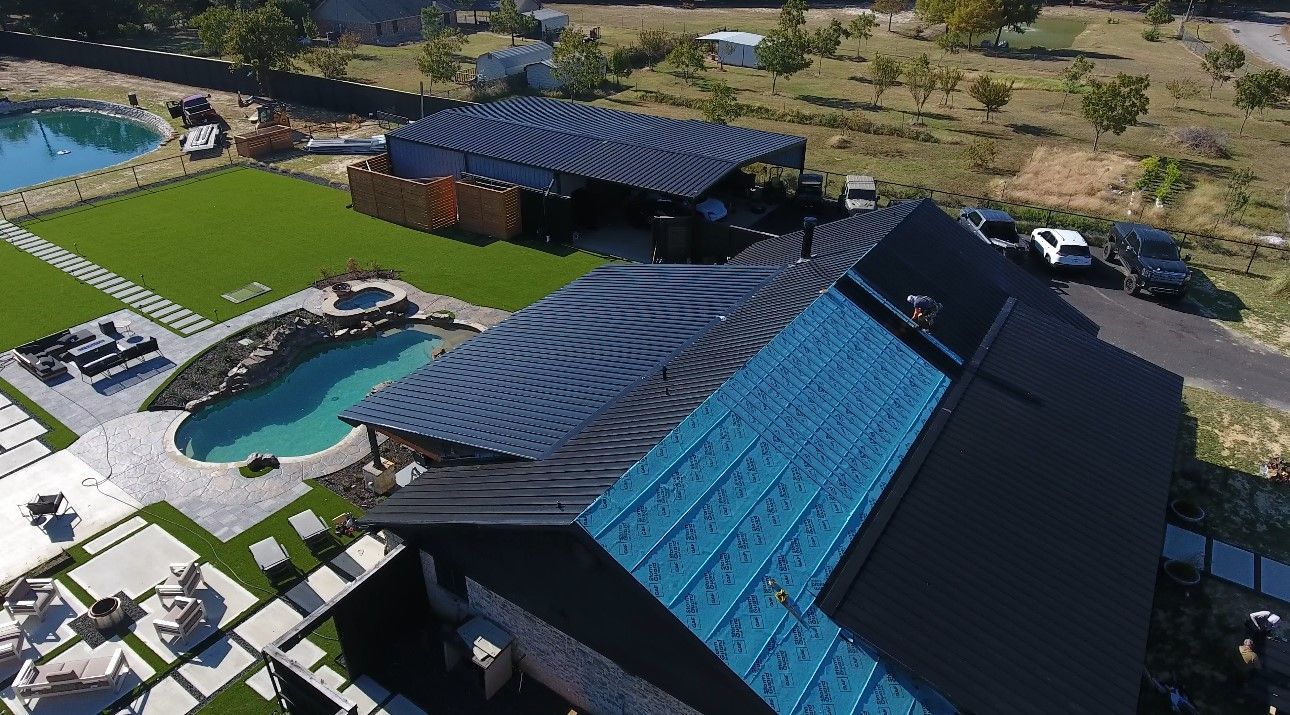
Material 5: Standing Seam Metal Roofing
Best for: Long-term commercial property ownership where lifecycle cost matters more than upfront cost
When a commercial property owner tells Swift Roofing they plan to own the building for 20 to 30 years and want to make one roofing decision, the conversation ends with standing seam metal. It is the only material on this list that outlasts two or three replacement cycles of every alternative.

According to the NRCA's metal roofing guidance, a properly installed metal roof can last 50 years or more with minimal maintenance. In Rockwall County's hail corridor, metal panels resist impact in ways that membrane systems cannot. Certain specifications qualify for Class 4 impact-resistant ratings, which produce meaningful commercial property insurance premium reductions, a benefit that Swift Roofing makes sure every North Texas property owner understands before they decide the upfront cost is too high.
| Performance factor | Standing Seam Metal in North Texas |
|---|---|
| Lifespan | 50+ years, outlasting 2 to 3 membrane replacement cycles |
| Hail resistance | Excellent. Class 4 impact rating available |
| Insurance premium impact | Class 4 rating can produce significant commercial premium reductions |
| Heat performance | Reflective coatings available, excellent thermal performance |
| No membrane vulnerability | Eliminates seam adhesion and puncture concerns entirely |
| Installed cost | Premium upfront, lower total lifecycle cost for long-term ownership |
The lifecycle math: A 50-year metal roof versus two TPO replacements and one EPDM replacement over the same period. The upfront premium on metal frequently disappears when the full ownership cost is laid out side by side.
Material 6: Built-Up Roofing (BUR)
Best for: Existing BUR systems receiving overlay or restoration, and applications requiring maximum puncture resistance

BUR is one of the oldest commercial roofing systems still in active use. Swift Roofing encounters it most often on commercial buildings in North Texas that were built before single-ply membrane systems became the standard. For these buildings, overlay or restoration is frequently more cost-effective than a full tear-off replacement.
| Performance factor | BUR in North Texas |
|---|---|
| Waterproofing redundancy | Multiple layers provide backup that single-ply cannot match |
| Foot traffic tolerance | Aggregate cap provides surface durability |
| Heat absorption | Dark system without reflective treatment is a disadvantage in Texas summers |
| Weight | Heavier than membrane systems. Structural verification required |
| Lifespan | 15 to 30 years depending on ply count and maintenance |
Limitations: BUR is not Swift Roofing's first recommendation for new construction in North Texas. For existing BUR buildings, it is the right conversation. For new builds, single-ply or metal almost always delivers better performance per dollar.
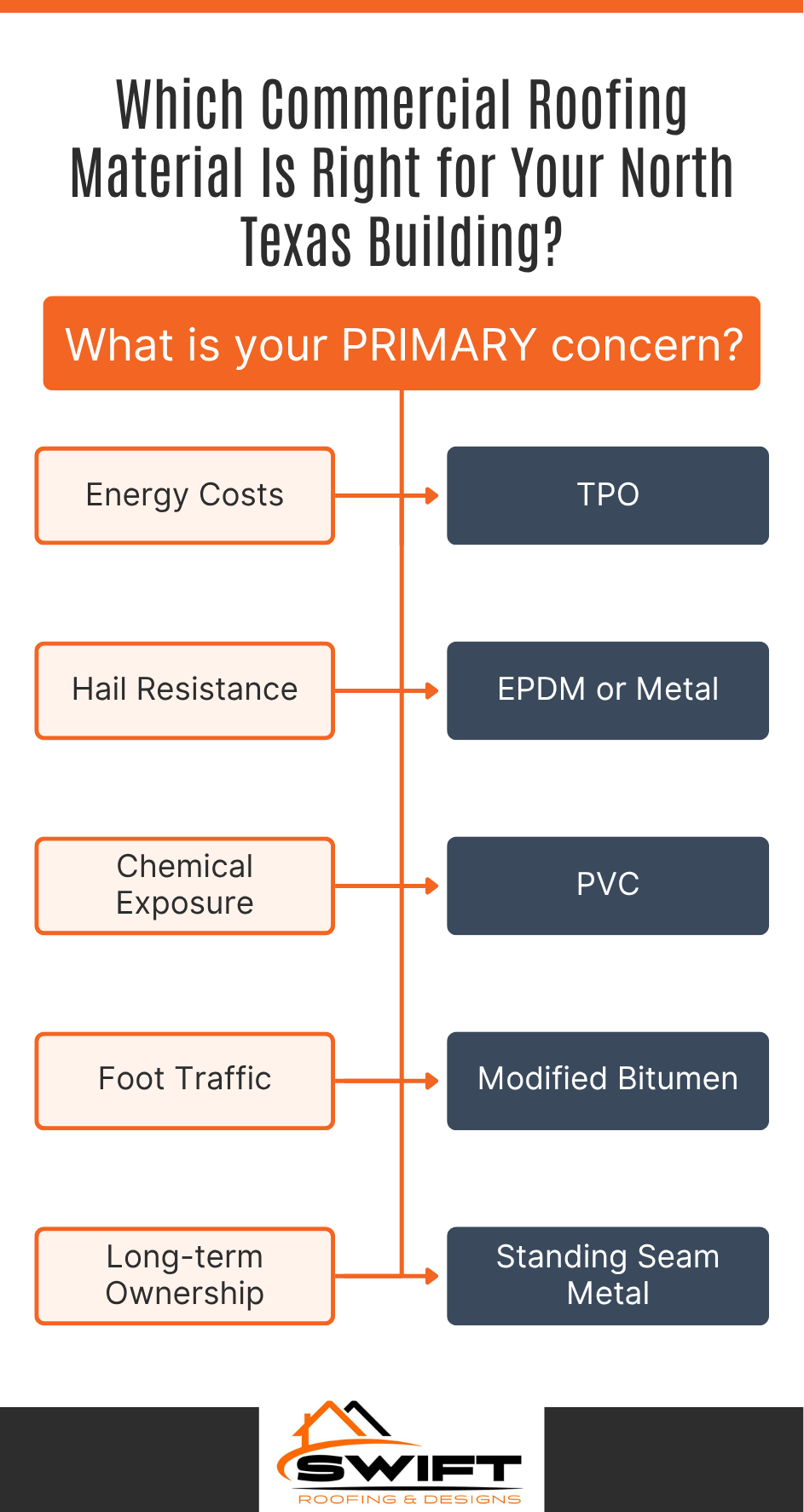
Which Material Is Right for Your Building?
The right material depends on four factors that require a site visit to evaluate correctly: roof slope and drainage, building use and exhaust conditions, ownership timeline, and the condition of the existing roof system. Swift Roofing personally handles every commercial inspection call.
Frequently Asked Questions
Does my commercial roof qualify for hail damage insurance coverage?
Most commercial property insurance policies in Texas cover hail damage as a covered peril. What determines how the claim resolves is the documentation of the damage before any repair or replacement begins. Swift Roofing provides written commercial roof inspections with photo documentation formatted for insurance adjuster review after every hail event.
How long does a commercial roof inspection take?
A thorough inspection on a standard-sized commercial building typically takes one to two hours. Swift Roofing provides written findings after every inspection, not just a verbal report, so you have documentation regardless of whether a claim follows.
Can I install a new commercial roof over the existing one?
In some cases, yes. Texas building code generally permits one overlay when the existing substrate is structurally sound and moisture-free. A professional moisture survey of the existing roof deck determines whether overlay is viable or whether full tear-off is required before the new system goes down.
How do I know if my commercial roof needs repair or full replacement?
The threshold Swift Roofing uses in the field: when repair costs approach 25 to 30 percent of full replacement cost, replacement typically delivers better long-term value. An honest inspection is the starting point for that determination. Swift Roofing will not push replacement if the repair case is strong.
Does Swift Roofing handle commercial insurance claims?
Yes. Swift Roofing documents hail and storm damage on commercial properties and works directly with insurance adjusters on claims throughout Royse City, Rockwall, McKinney, and the surrounding North Texas service area.
Request a Roofing Quote
Blog Form
We will get back to you as soon as possible.
Please try again later.
More Posts Like This:
Choose Swift Roofing & Designs for Top Quality Roofing
Need a reliable roofer? We've helped countless clients protect their homes while saving time and money, and we’re ready to help you next.