What Texas Property Owners Should Know About TPO Roof Lifespan
Walk around the exterior and look for:
- Missing or visibly lifted shingles
- Uneven rooflines
- Granules collecting heavily near downspouts
- Damaged flashing you can see safely from the ground
- Debris still sitting in valleys
- Gutters pulling away or holding water
Then check the attic or upper interior if safely accessible:
- Water stains on decking or rafters
- Darkened wood
- Damp insulation
- Daylight where it should not be visible
- Musty odor after rain
- Previous repair patches and where they were made
Our free roof inspection service includes shingles, flashing, decking, attic ventilation, drainage, and interior warning signs, with photo documentation so you can compare what you noticed with what the inspector finds.
| Inspection Result | Targeted Repair May Make Sense When | Larger Scope May Be Needed When |
|---|---|---|
| Hail damage | Limited, repairable damage is isolated | Impact damage is widespread across multiple slopes |
| Lifted shingles | Small number of compatible shingles can be repaired | Wind failure is widespread or shingles are brittle |
| Flashing failure | Detail can be rebuilt without disturbing large roof areas | Water has damaged surrounding decking or multiple transitions |
| Moisture intrusion | Entry point is isolated and decking remains sound | Decking, insulation, or multiple roof areas are affected |
The better approach is to combine age with condition, repair frequency, storm history, and moisture findings. Our article on four roof inspection findings that lead to bigger repairs explains why lifted shingles, failed flashing, hail damage, and hidden moisture should be judged by how they are progressing, not only by how old the roof is.
Ask these questions before accepting either recommendation:
- What exact condition makes restoration possible or impossible?
- Is the decking sound?
- How many slopes are affected?
- Is there hidden moisture?
- Are the existing shingles flexible enough to work around safely?
- What repairs must happen before restoration?
- How much useful life are we realistically trying to gain?
- If we restore now, what would still trigger replacement later?
Those questions turn a sales estimate into a roof-condition discussion.
What Does Restoration vs. Replacement Cost in North Texas?
For estimated market context, asphalt shingle replacement in North Texas is commonly planned around $300 to $600 per roofing square installed, with one roofing square equal to 100 square feet of roof surface. For broader planning context, a typical Texas roof replacement can fall in the $8,000 to $20,000 range, depending on roof size, material, pitch, design complexity, access, and the amount of work required once the existing system is opened up.
Those numbers are useful for early budgeting, but they should be treated as planning ranges rather than a price for a specific home. Roof surface area is different from living square footage because pitch, overhangs, garages, porches, valleys, and roof geometry all change the actual amount of roofing material and labor involved.
Homeowners can collect useful information without climbing onto the roof. Use binoculars or a phone camera from the ground, and inspect the attic or interior only where access is safe. Wet roofs, steep slopes, and hidden weak decking make rooftop inspection a job for trained professionals.
What to Check From the Ground
- Shingle tabs that appear missing, raised, shifted, or visibly damaged
- Flashing that looks bent or separated from adjacent materials
- Debris concentrated in roof valleys or behind penetrations
- Sagging gutter sections, disconnected downspouts, or water marks on fascia
- Tree branches touching the roof or broken limbs resting on it
- Uneven roof planes or a localized dip that was not present before
What to Check Inside the Home or Attic
- New stains on ceilings, walls, rafters, or roof decking
- Damp insulation or a musty odor after rain
- Daylight showing through an unexpected opening
- Rust around fasteners, vents, or metal components
- Peeling paint near the ceiling line or around penetrations
When to Request Professional Help
Write down when each sign appears, and take photos from the same position for future comparisons. If you see an active leak, significant displacement, or storm debris, move belongings away and request professional help rather than attempting a rooftop patch.
After a storm, the same checklist can help you describe what happened, but visible damage may represent only part of the condition. Swift Roofing & Designs offers storm-damage inspections when wind or hail is the likely cause. For an active opening or urgent water entry, emergency roof repair may be the safer route.
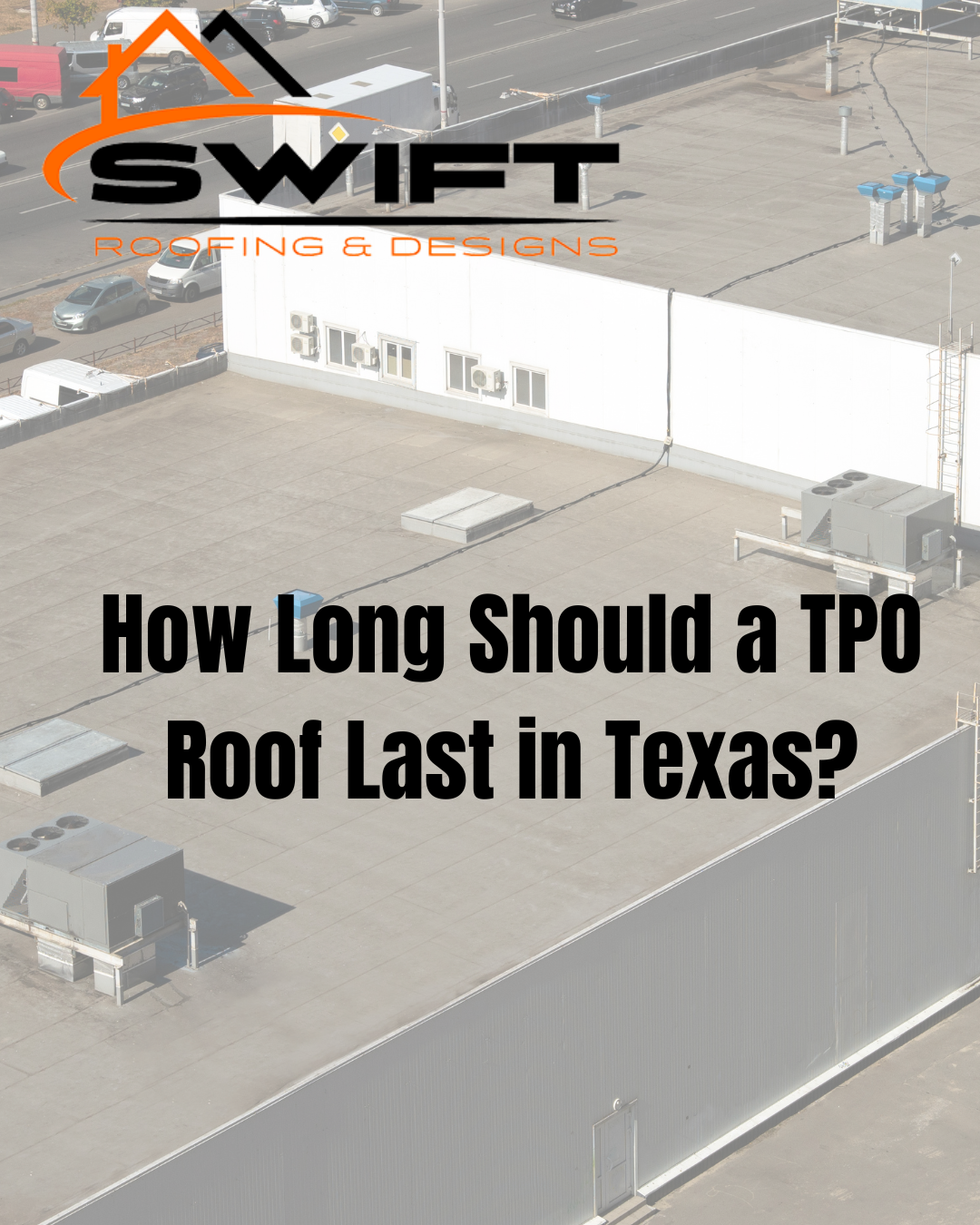
The useful answer to how long does a TPO roof last in Texas is not a single number. A properly installed and maintained system may provide 15 to 25 years of service. Two same-age membranes can perform differently because their drainage, traffic, insulation, attachment, and maintenance histories differ. Age should start the conversation, not settle the repair or replacement decision.
North Texas adds intense sunlight, heat, hail, strong winds, and sharp weather changes. Cooler-weather inspections create an opportunity to document membrane condition before another season compounds hidden weaknesses. This guide explains what controls
TPO roof lifespan and how owners in Royse City, Rockwall, Fate, and Greenville can plan the next step. The goal is to avoid both premature replacement and repeated repairs on an unreliable system.
How Long Does a TPO Roof Usually Last in Texas?
Swift Roofing & Designs identifies 15 to 25 years as a typical TPO range for North Texas properties. That range is not a promise that every roof will reach the same age. Effective drainage and scheduled maintenance improve the chance of reaching the upper end. Chronic ponding, vulnerable details, heavy traffic, or storm damage may require major work sooner.
Manufacturer information also supports viewing longevity as a system outcome. GAF says typical single-ply guarantees can range from 20 to 35 years when installation and maintenance meet manufacturer requirements. GAF’s TPO field research also found sampled 8- to 16-year-old membranes performing above current ASTM requirements for new material. These findings show why inspection is more reliable than declaring a roof finished at a certain age.
| Roof condition and history | Reasonable planning outlook | What the owner should verify |
|---|---|---|
| Newer, well-documented system | Work toward the full expected service range | Warranty, membrane, attachment, drainage, and inspection schedule |
| Midlife roof with isolated defects | Continued service may be practical after repairs | Moisture extent, seam condition, flashing, and repair compatibility |
| Aging roof with repeated leaks | Remaining life depends on whether failures are localized | Repair history, wet insulation, substrate condition, and leak pattern |
| Roof with widespread moisture or attachment failure | Replacement planning may be more economical | Core samples, moisture mapping, deck condition, and system design |
Why North Texas Weather Can Shorten TPO Performance
North Texas exposes commercial roofs to more than heat. The National Weather Service describes the Dallas-Fort Worth climate as having hot summers, wide temperature swings, wet transition seasons, hail, and damaging winds. Those conditions stress membranes, seams, flashings, fasteners, and edges. Properly designed TPO can handle demanding weather, but small weaknesses become more consequential here.
Heat and UV exposure age surfaces while temperature changes make materials expand and contract. Hail may bruise the membrane or damage insulation without producing an obvious opening. Heavy rain reveals blocked drains, low areas, and flashing defects that dry weather conceals. A Texas
commercial roof lifespan therefore depends on managing stress points as well as choosing the membrane.
Installation Quality Sets the Starting Point
Workmanship and system design shape every year that follows installation. TPO is an assembly of membrane, seams, insulation, attachment, flashing, drainage, penetrations, and perimeter details. GAF describes TPO as a heat-welded single-ply membrane with long-term heat and UV resistance. Those benefits still depend on correct field execution.
Important installation decisions include:
- Membrane and attachment: Product, thickness, and attachment should match exposure, deck type, traffic, wind demands, and warranty requirements.
- Seam welding: Consistent heat, speed, pressure, and preparation are necessary for durable welded seams.
- Insulation and cover board: Sub-membrane layers affect thermal performance, impact resistance, and traffic durability.
- Drainage: Tapered insulation, drains, scuppers, and overflow paths should prevent persistent ponds.
- Flashing and edges: Curbs, pipes, walls, corners, hatches, and perimeters need compatible, secure transitions.
Keep the contract, product data, warranty, inspection reports, repairs, and photographs together. These records clarify what was installed and help contractors avoid incompatible repairs. An inspection can establish a baseline when records are incomplete. Swift’s commercial roofing services include documented inspections, TPO installation, repair, replacement, and maintenance.
Drainage, Traffic, and Rooftop Equipment Affect Longevity
Water that remains after rain adds weight and repeatedly tests seams, drains, and flashing. Ponding does not prove failure, but it can reveal poor slope, compressed insulation, movement, or blockage. Identify why water remains and whether it entered the assembly. A clogged drain may need maintenance, while saturated insulation requires a different plan.
Rooftop activity can matter as much as weather. Other trades may drag equipment, drop tools, or walk outside protected routes. Condensate lines and mechanical curbs also create moisture and flashing concerns. Walk pads, controlled access, post-work inspections, and access logs reduce preventable damage.
Membrane Thickness Is Only One Part of Durability
A thicker membrane may suit demanding properties, but thickness is not a shortcut for overall quality. A strong specification pairs the membrane with appropriate insulation, attachment, flashing, drainage, edge securement, and workmanship. It should account for hail, traffic, equipment, interior use, and ownership goals. The cheapest assembly may not deliver the lowest lifecycle cost.
Use these questions when comparing TPO proposals:
- What membrane, thickness, attachment method, and manufacturer are specified?
- Does the scope include cover board, and what performance need does it address?
- How will tapered insulation, drains, scuppers, and overflow drainage be handled?
- Which wind, code, and manufacturer requirements apply?
- How are penetrations, walls, curbs, edges, and transitions detailed?
- What workmanship and manufacturer warranties are included, and what maintenance preserves them?
- Are tear-off, wet materials, deck repairs, permits, and disposal addressed?
The answers should form one coherent assembly, not a list of premium parts. A thicker membrane cannot correct poor slope or weak flashing. Johns Manville’s TPO system resources show the importance of seams, curbs, drains, vents, walk pads, and edges. The contractor should explain which details matter on the building and why.
TPO Roof Maintenance Helps Preserve Serviceable Years
Effective TPO roof maintenance is a documented routine, not a parking-lot glance. Inspections should account for warranty requirements, exposure, storms, and work by other trades. GAF advises owners to establish an inspection and maintenance program after installation. Consistent records show whether defects are isolated, recurring, or spreading.
A practical maintenance program should include:
- Inspecting the roof on a planned schedule and after significant hail, wind, or heavy rain.
- Removing leaves, trash, branches, and sediment from drains, scuppers, and gutters.
- Checking seams, patches, flashings, terminations, edges, curbs, and penetrations.
- Looking for punctures, cuts, open welds, displaced components, and ponding.
- Limiting access and requiring trades to use designated walkways.
- Inspecting after HVAC, electrical, sign, satellite, or other rooftop work is completed.
- Documenting each finding with dated photographs, locations, actions, and follow-up dates.
- Using compatible repair materials instead of generic sealants.
Compare current photographs with prior reports. An unchanged seam may remain a monitoring item, while recurring repairs indicate a pattern. Indoor stains may not sit directly beneath a membrane defect because water can travel. Swift’s infrared versus visual inspection guide explains why hidden moisture may require more than a surface review.
When Does a TPO Roof Need Repair or Replacement?
A repair makes sense when the defect is localized, the membrane remains serviceable, and moisture has not spread. Examples include an isolated puncture, flashing defect, or limited seam problem. Replacement becomes more reasonable when leaks recur, wet insulation is widespread, or attachment is failing. Consider the remaining life of the whole assembly, not only whether one hole can be patched.
Age matters because older membranes may become harder to repair, but age is not proof of failure. A 17-year-old dry roof may be a better repair candidate than a newer roof with chronic ponding. Testing may include seam probing, core samples, moisture scanning, and drainage review. The report should explain why maintenance, repair, restoration, or
TPO roof replacement is justified.
| Inspection finding | Likely direction | Evidence needed before deciding |
|---|---|---|
| Isolated puncture or open detail | Targeted repair | Dry surrounding assembly and compatible repair method |
| Repeated leak at one transition | Redesign or rebuild the detail | Leak history, flashing condition, and moisture extent |
| Aging membrane with sound assembly | Maintenance, repair, or possible restoration | Adhesion, repairability, warranty, and moisture testing |
| Widespread wet insulation | Replacement of affected or broader areas | Moisture map, core cuts, insulation condition, and deck review |
| Broad seam, attachment, or edge failure | Replacement planning | Wind damage, system design, repair history, and remaining reliability |
Use a Lifecycle Decision Framework Before Approving Work
Property owners need more than competing repair and replacement quotes. Compare expected reliability, retained risk, operational disruption, and the next likely capital expense. Repeated low-cost repairs can exceed the value they preserve, while early replacement wastes serviceable years. Start with evidence and evaluate the expected ownership period.
Use this framework:
- Maintain and monitor when the membrane, seams, flashing, insulation, and drainage remain functional and no active failure is found.
- Repair when a qualified contractor can isolate the defect, confirm the surrounding assembly is dry, and restore the detail compatibly.
- Restore when appropriate only when testing shows a suitable substrate and the proposed system is compatible with the existing TPO and warranty conditions.
- Replace a section when damage or moisture is concentrated in a definable area and reliable tie-ins are possible.
- Replace the system when failures are widespread, moisture has spread, attachment is compromised, or repeated repair costs no longer buy dependable service.
- Plan rather than react when the roof is approaching the end of its expected range but is not yet leaking, giving time for budgeting, tenant coordination, and specification review.
The framework applies across Royse City, Rockwall, Fate, and Greenville, but building conditions vary. Open exposure can increase wind demands, trees add debris, and equipment increases traffic and penetrations. Hail paths and maintenance history can separate neighboring roofs of the same age. Swift uses documented findings instead of a generic calendar.
Estimated 2026 Market Context
We price each TPO roofing project after evaluating the roof size, membrane thickness, attachment method, insulation, penetrations, drainage, and existing deck condition. For general budgeting, Fixr’s 2026 TPO cost guide lists approximately
$4.50 to $16 per square foot installed. Tear-off requirements, deck repairs, roof access, permits, warranties, and project staging can significantly affect the final scope. An onsite inspection allows us to prepare an itemized recommendation and dependable estimate for the actual commercial property.
| Cost factor | How it changes scope | What an itemized proposal should show |
|---|---|---|
| Roof area and access | Affects material, labor, staging, cranes, and safety planning | Measured area and access assumptions |
| Tear-off and disposal | Adds labor and reveals concealed conditions | Number of layers and disposal allowance |
| Insulation and cover board | Changes thermal value and impact resistance | Material, thickness, fastening, and quantities |
| Drainage corrections | May require tapered insulation, drains, or scuppers | Slopes, components, and tie-in details |
| Deck or wet-material replacement | Often cannot be fully known before opening the roof | Unit prices or documented allowances |
| Membrane and attachment | Thickness and system design affect material and labor | Manufacturer, product, thickness, and method |
| Flashing and penetrations | Complex roofs require more detailed labor | Count and treatment of curbs, walls, pipes, and edges |
| Warranty and inspections | Requirements can affect approved assembly and workmanship | Coverage, duration, exclusions, and owner duties |
Frequently Asked Questions
Can a TPO roof last longer than 25 years in Texas?
Some systems may remain serviceable beyond 25 years, but owners should not assume that outcome from age or appearance alone. Installation quality, membrane specification, drainage, storm exposure, roof traffic, maintenance, and repair history all matter. Testing can show whether the assembly remains dry and repairable as it ages. Plan around verified condition rather than treating an upper-end lifespan as a guarantee.
Does a white TPO membrane reduce cooling costs?
White TPO is reflective and can reduce roof-surface heat compared with darker materials under suitable conditions. The U.S. Department of Energy identifies TPO and PVC as commonly white, reflective membrane options used in cool roofs. Actual building savings depend on insulation, climate, HVAC performance, roof condition, utility rates, and operating patterns. Reflectivity is useful, but it should be one part of the full roof and energy strategy.
How often should a commercial TPO roof be inspected?
Follow the manufacturer and warranty requirements first because inspection obligations vary by system. Many properties benefit from planned professional reviews and additional checks after significant hail, wind, heavy rain, or rooftop trade work. High-traffic or problem roofs may require closer monitoring than low-access buildings. The important practice is to use a consistent schedule and close out documented findings promptly.
Can ponding water ruin a TPO roof?
Ponding water is a warning that drainage, slope, insulation, or structural conditions deserve evaluation. It can keep seams and flashings under prolonged moisture exposure and may indicate compression or movement beneath the membrane. The response should address the reason water remains, not only remove the water after each storm. A contractor should also determine whether moisture has entered the assembly.
Can an older TPO roof still be repaired?
Yes, when the membrane remains cleanable and weldable, the defect is limited, and surrounding materials are dry and sound. Repair compatibility and manufacturer guidance matter because generic patching materials may not create a durable result. An aged roof with recurring failures or widespread moisture may no longer be an economical repair candidate. Testing should decide whether the repair restores meaningful service life or only delays replacement briefly.
What records should a commercial property owner keep?
Keep the original specification, warranty, closeout documents, product information, inspection reports, repair invoices, photographs, leak logs, and rooftop access records. Record the location and date of each issue instead of relying on memory. These records reveal patterns and help contractors distinguish a new defect from a recurring one. They also support budgeting, warranty communication, insurance documentation, and future property transactions.
Protect the Remaining Life of Your North Texas TPO Roof
The real answer to how long a TPO roof lasts in Texas comes from its current condition, not its installation date alone. Swift Roofing & Designs inspects commercial membranes, seams, drainage, flashings, penetrations, edges, and accessible signs of hidden moisture. We document what we find and explain whether the roof needs maintenance, a focused repair, replacement planning, or no immediate work. That approach helps property owners protect operations and budget around evidence.
If you manage a commercial property in Royse City, Rockwall, Fate, or Greenville, schedule an inspection before a small weakness becomes an interior disruption. Review our commercial roofing services or contact Swift Roofing & Designs to request a free, photo-documented assessment. We will explain the roof’s likely remaining service life and the factors that could change it. You will receive a clear next step without pressure to replace a system that still has useful life.
Request a Roofing Quote
Blog Form
We will get back to you as soon as possible.
Please try again later.
More Posts Like This:
Choose Swift Roofing & Designs for Top Quality Roofing
Need a reliable roofer? We've helped countless clients protect their homes while saving time and money, and we’re ready to help you next.