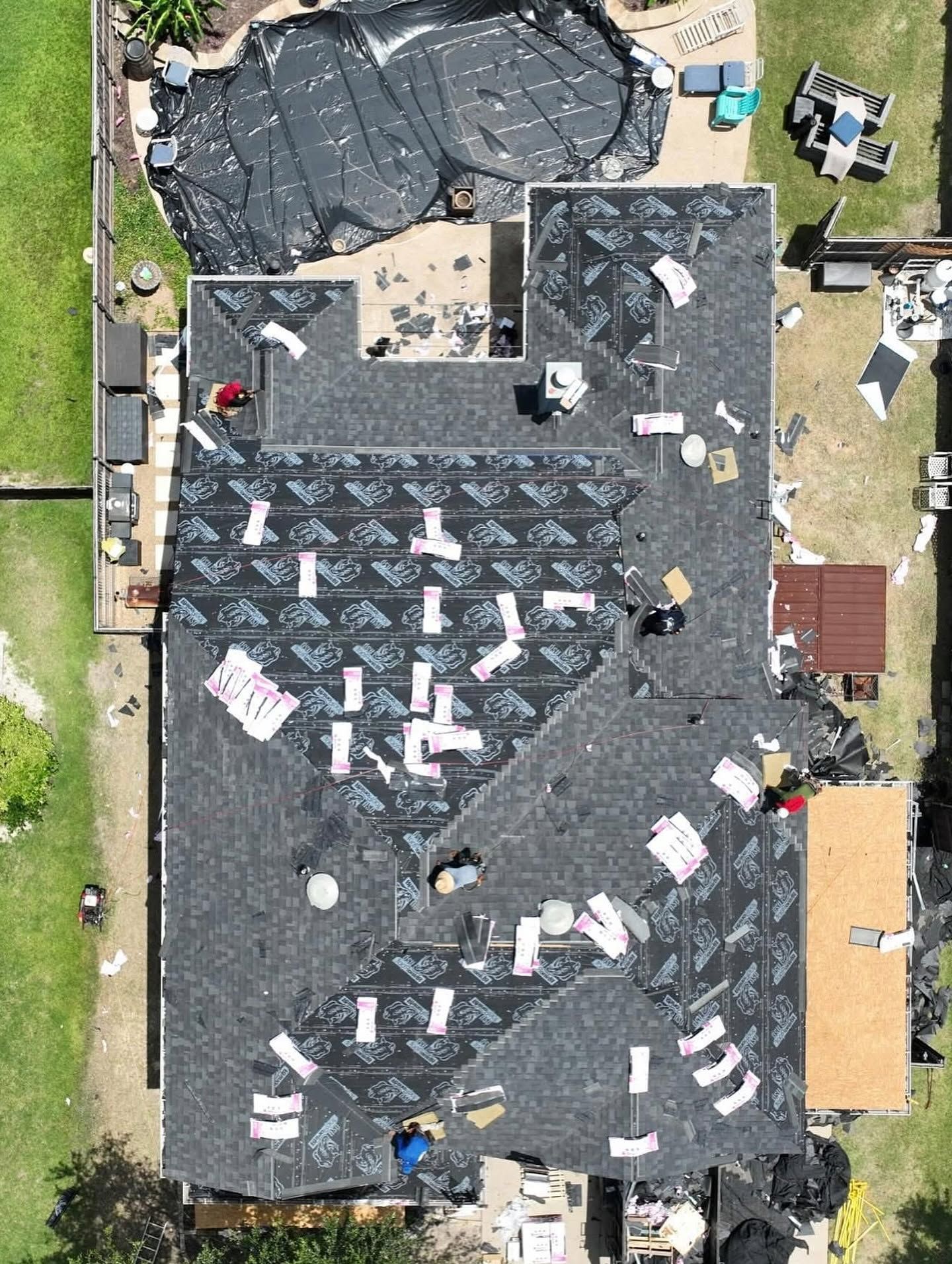
Why Does My Roof Leak Only During Heavy Rain in North Texas?
Walk around the exterior and look for:
- Missing or visibly lifted shingles
- Uneven rooflines
- Granules collecting heavily near downspouts
- Damaged flashing you can see safely from the ground
- Debris still sitting in valleys
- Gutters pulling away or holding water
Then check the attic or upper interior if safely accessible:
- Water stains on decking or rafters
- Darkened wood
- Damp insulation
- Daylight where it should not be visible
- Musty odor after rain
- Previous repair patches and where they were made
Our free roof inspection service includes shingles, flashing, decking, attic ventilation, drainage, and interior warning signs, with photo documentation so you can compare what you noticed with what the inspector finds.
| Inspection Result | Targeted Repair May Make Sense When | Larger Scope May Be Needed When |
|---|---|---|
| Hail damage | Limited, repairable damage is isolated | Impact damage is widespread across multiple slopes |
| Lifted shingles | Small number of compatible shingles can be repaired | Wind failure is widespread or shingles are brittle |
| Flashing failure | Detail can be rebuilt without disturbing large roof areas | Water has damaged surrounding decking or multiple transitions |
| Moisture intrusion | Entry point is isolated and decking remains sound | Decking, insulation, or multiple roof areas are affected |

The better approach is to combine age with condition, repair frequency, storm history, and moisture findings. Our article on four roof inspection findings that lead to bigger repairs explains why lifted shingles, failed flashing, hail damage, and hidden moisture should be judged by how they are progressing, not only by how old the roof is.
Ask these questions before accepting either recommendation:
- What exact condition makes restoration possible or impossible?
- Is the decking sound?
- How many slopes are affected?
- Is there hidden moisture?
- Are the existing shingles flexible enough to work around safely?
- What repairs must happen before restoration?
- How much useful life are we realistically trying to gain?
- If we restore now, what would still trigger replacement later?
Those questions turn a sales estimate into a roof-condition discussion.
What Does Restoration vs. Replacement Cost in North Texas?
For estimated market context, asphalt shingle replacement in North Texas is commonly planned around $300 to $600 per roofing square installed, with one roofing square equal to 100 square feet of roof surface. For broader planning context, a typical Texas roof replacement can fall in the $8,000 to $20,000 range, depending on roof size, material, pitch, design complexity, access, and the amount of work required once the existing system is opened up.
Those numbers are useful for early budgeting, but they should be treated as planning ranges rather than a price for a specific home. Roof surface area is different from living square footage because pitch, overhangs, garages, porches, valleys, and roof geometry all change the actual amount of roofing material and labor involved.

A roof that stays dry during light rain but leaks during a hard North Texas storm usually has a specific weak point that only shows itself when water volume, wind direction, or drainage demand increases.
At Swift Roofing & Designs, we see this pattern often in Royse City and the I-30 corridor. The roof may not have a large open hole. Instead, water may be getting under lifted shingles, behind flashing, around a pipe boot, into a valley, or through a transition that performs normally until heavy rain pushes more water through the area.
That is why a
roof leak after heavy rain should be diagnosed by the conditions that make it happen, not just by the stain that appears inside. The location of the ceiling stain matters, but the timing, wind direction, and storm intensity often tell us even more.
Why September 2026 Is a Useful Time to Diagnose the Leak
North Texas is getting a real example of this problem right now.
The National Weather Service forecast for Royse City issued September 2, 2026 calls for showers and thunderstorms Wednesday night into Thursday, with heavy rainfall possible. NWS Royse City forecast
The Fort Worth/Dallas NWS office is also tracking localized heavy rainfall associated with the remnants of Tropical Storm Edouard, with the highest regional rain chances from Wednesday into Thursday morning. NWS Fort Worth/Dallas
Not every part of North Texas will receive the same rainfall, and Royse City may see very different totals from communities farther southeast. That unevenness is exactly why storm-specific leak patterns matter.
If your roof leaks this week, write down:
- When the leak starts after rain begins
- Whether wind is strong at the time
- Which direction the rain is coming from
- Whether the leak stops when rainfall becomes lighter
- Whether the same spot leaked during previous storms
- Whether shingles, flashing, or debris were displaced beforehand
Our North Texas thunderstorm emergency guide explains why late-summer and early-fall storms often expose weaknesses that have already been stressed by heat, UV exposure, wind, and earlier hail.
Why a Roof Can Leak Only When the Rain Gets Heavy
A roofing system is designed to shed water in layers.
Shingles move water downslope. Flashing redirects it around walls, chimneys, valleys, skylights, and other transitions. Pipe boots seal roof penetrations. Gutters move water away from the roof edge.
When one of those details is marginal rather than completely failed, light rain may not put enough water against it to create an interior leak. Heavy rain changes the load.
What Changes During a Hard Storm
- Higher rainfall rates send more water across shingles, valleys, and flashing.
- Strong wind pushes rain sideways and under vulnerable edges.
- Repeated gusts work at already-loose shingles and flashing.
- Roof valleys concentrate runoff into smaller sections.
- Gutter backup can hold water near the roof edge longer.
- Long-duration rain gives small entry points more time to admit water.
Swift Roofing & Designs treats heavy rain as the stress test, not necessarily the original cause.
The storm may simply reveal a flashing joint, cracked boot, lifted shingle, or damaged roof section that was already vulnerable.
Six Common Causes of a Roof Leaking During Heavy Rain
1. Lifted or poorly sealed shingles
Wind can break the adhesive bond beneath a shingle tab without removing the shingle completely. The roof may look normal from the ground, but wind driven rain roof leak symptoms can appear when water is pushed beneath the lifted edge.
2. Failed flashing
Flashing protects transitions at chimneys, walls, dormers, skylights, and other penetrations. If metal has shifted, corroded, or separated, heavy rain can exploit the opening.
3. Cracked pipe boots
The rubber collar around a plumbing vent can split or deteriorate before the surrounding shingles fail. Water then follows the pipe or roof opening downward.
4. Valley problems
Roof valleys handle concentrated runoff from multiple roof planes. Debris, worn shingles, installation problems, or damaged valley material can create leaks that only appear when water volume rises.
5. Gutter or roof-edge backup
A clogged or poorly draining gutter can keep water at the roof edge longer than intended. That can expose weaknesses in drip edge, fascia, lower shingles, or decking.
6. Hidden decking damage
Water from an older leak may already have weakened a small section of decking. New rainfall can then travel farther through the assembly before becoming visible inside.
Our roof repair service in Royse City starts by tracing the actual entry point rather than patching directly above the interior stain.
Use the Leak Pattern to Narrow Down the Cause
That is why we ask homeowners what the storm was doing when the leak appeared.
Leak Timing Clues
| What Happens | What We Investigate First |
|---|---|
| Leaks only in wind-driven rain | Lifted shingles, wall flashing, roof transitions |
| Leaks only after long steady rain | Small flashing gaps, decking, valleys |
| Leaks immediately when rain starts | Active opening or recurring known leak |
| Appears near plumbing vent | Pipe boot and surrounding shingles |
| Appears near chimney or wall | Step flashing and counterflashing |
| Appears below roof valley | Valley material, nearby shingles, decking |
| Stops as soon as rain weakens | Capacity or wind-related weak point |
| Keeps dripping after storm ends | Water stored in insulation, decking, or framing |
A ceiling leak after rain also may not sit directly below the roof entry point.
Water can travel along decking, rafters, nails, insulation, and framing before it finds an opening into the finished ceiling.
That is why repairing the roof directly above the stain can fail if the actual entry point is several feet uphill.
A 15-Minute Check You Can Do During the Next Storm
Do not climb onto the roof during rain.
Inside the House
Check the attic or upper rooms only if they are safely accessible.
Look for:
- Active dripping
- Wet roof decking
- Water trails along rafters
- Damp insulation
- New ceiling stains
- Bubbling paint or drywall
- Water near vents, chimneys, or exterior walls
From the Ground Outside
Look for:
- Shingles in the yard
- Lifted roof edges
- Tree limbs or debris on the roof
- Water overflowing gutters
- Flashing pieces on the ground
- A visibly damaged ridge or roof transition
Record the Storm Conditions
Write down:
- Approximate time the leak started
- How hard it was raining
- Whether the wind was strong
- Which side of the house was taking the weather
- Whether the leak changed when the rain intensity changed
Photos of the interior stain and any safe ground-level exterior evidence help us compare the symptoms with what we find during the inspection.
Our free roof inspection service includes the roof surface, flashing, vents, decking, attic, gutters, and interior warning signs.
What Not to Do When the Roof Starts Leaking
The first priority is protecting the interior without creating another safety problem.
Do not:
- Climb onto a wet roof
- Try to lift shingles during a storm
- Apply roof cement blindly from the attic
- Assume the leak is directly above the ceiling stain
- File an insurance claim before understanding what caused the leak
Do:
- Move valuables away from the water
- Use containers to control dripping
- Photograph the damage
- Mark the edge of a stain so you can see whether it grows
- Shut off electricity to an affected area if water is near fixtures and it is safe to do so
- Schedule an inspection once the roof can be evaluated safely
If water is actively entering the home, decking is exposed, or a storm has caused visible structural damage, our emergency roof repair service can provide tarping, leak control, and stabilization before permanent repairs begin.
When a Targeted Roof Leak Repair Is Enough
At Swift Roofing & Designs, many of the repair calls we inspect end with a targeted repair because the failure is limited to one component.
Repair usually makes sense when:
- Damage is localized
- Surrounding shingles still have useful life
- Decking is sound outside the leak area
- One flashing detail has failed
- A pipe boot is cracked
- A small number of shingles have lifted or blown off
- The leak is the first isolated problem on an otherwise healthy roof
A larger scope deserves comparison when the inspection finds widespread shingle deterioration, repeated leaks in unrelated areas, extensive decking damage, or storm damage across several slopes.
Our storm damage repair service documents wind, hail, heavy-rain, and debris damage with photos so the repair decision is based on evidence rather than the size of the ceiling stain.
Repair vs Larger Scope.
| Inspection Finding | Targeted Repair May Fit | Larger Scope May Be Needed |
|---|---|---|
| Lifted shingles | Small isolated group | Widespread wind failure |
| Flashing leak | One transition | Multiple failed transitions |
| Pipe boot | One failed penetration | Several aging penetrations plus roof wear |
| Decking | Small localized section | Extensive soft or rotted areas |
| Storm damage | One repairable area | Damage spread across multiple slopes |
| Leak history | First isolated leak | Repeated unrelated leaks |
The decision should answer one question:
what will still be vulnerable after the repair is completed?
What Does Roof Leak Repair Cost in North Texas?
For Estimated 2026 Market Context, Dallas-area roof repairs average about $657, with many projects falling between approximately $262 and $1,081. For roof leaks specifically, current 2026 market data commonly places professional repair around $360 to $1,550, depending on the source of the leak, roof access, material, and the amount of damage that has developed below the surface.
Those figures are useful for early budgeting, but a flashing repair, cracked vent boot, small shingle repair, and leak involving damaged decking are very different projects.
We start with a
free inspection, document the problem with photos, and provide a clear, itemized estimate before repair work begins.
Estimated 2026 Roof Leak Repair Context
| Repair Context | Estimated Market Range |
|---|---|
| Typical Dallas-area roof repair | $262-$1,081 |
| Average Dallas-area roof repair | About $657 |
| Professional roof leak repair | $360-$1,550 |
| Minor shingle or flashing repair | Often toward the lower end |
| Decking or widespread storm damage | Can move beyond the typical range |
What Changes the Final Repair Cost?
- Leak source: Shingle, flashing, pipe boot, valley, and decking repairs require different work.
- Roof pitch: Steeper roofs require more safety setup.
- Access: Difficult roof sections can increase labor.
- Material matching: Older shingles may require more sourcing.
- Decking damage: Soft wood adds removal and replacement.
- Flashing complexity: Chimneys and wall transitions take more work.
- Storm damage: Wind or hail may expand the affected area.
- Interior moisture: Insulation or drywall damage may be separate from roof work.
The useful comparison is not simply whether one estimate is lower. It is whether the proposed repair fixes the actual entry point and leaves sound roofing around it instead of treating only the visible symptom.
Frequently Asked Questions
Why does my roof leak only when it rains hard?
Heavy rain increases water volume and often arrives with stronger wind. That can expose small flashing gaps, lifted shingles, cracked penetrations, valley problems, or roof-edge weaknesses that do not leak during lighter rain.
Can wind-driven rain get under shingles without missing shingles?
Yes. Wind can break shingle seal bonds or push water under lifted edges even when the shingle is still physically present. A roof inspection can identify creased, lifted, or poorly sealed areas.
Why is my ceiling leak not directly below the roof damage?
Water can travel along decking, rafters, framing, nails, and insulation before it reaches the ceiling. The interior stain shows where water exited the roof assembly, not necessarily where it entered.
Should I file an insurance claim for a roof leak after a storm?
Not automatically. First determine whether the cause is sudden storm damage, normal wear, maintenance, or another issue. We recommend getting the roof inspected and documented before deciding whether a claim makes sense.
Does Swift Roofing & Designs repair roof leaks outside Royse City?
Yes. We provide roof leak repair and storm damage service throughout Royse City and nearby North Texas communities, including Rockwall, Fate, Caddo Mills, and the surrounding I-30 corridor.
Find the Entry Point Before the Next Heavy Rain Tests It Again
A roof that leaks only during hard rain is still leaking for a reason.
At Swift Roofing & Designs, we use the storm pattern, interior evidence, roof inspection, attic findings, and condition of the surrounding roofing to find that reason.
Sometimes the repair is a pipe boot. Sometimes it is flashing. Sometimes a small group of wind-lifted shingles needs to be replaced. And sometimes heavy rain exposes a larger storm-damage problem that needs a broader plan.
For Royse City homeowners dealing with a roof leak after heavy rain, the next step is not guessing where to apply sealant. It is identifying the actual water path and fixing the component that failed before the next North Texas storm tests it again.
Roof Repair in Royse City
Free Roof Inspection
Storm Damage Roof Repair
Emergency Roof Repair
North Texas Thunderstorm Roofing Emergencies
Roof Inspection Findings That Lead to Bigger Repairs
Request a Roofing Quote
Blog Form
We will get back to you as soon as possible.
Please try again later.
More Posts Like This:
Choose Swift Roofing & Designs for Top Quality Roofing
Need a reliable roofer? We've helped countless clients protect their homes while saving time and money, and we’re ready to help you next.