Black and white house icon with roof, chimney, and round window.

TPO vs Modified Bitumen: Which Flat Roofing System Is Better for North Texas?

October 19, 2026

Walk around the exterior and look for:

  • Missing or visibly lifted shingles
  • Uneven rooflines
  • Granules collecting heavily near downspouts
  • Damaged flashing you can see safely from the ground
  • Debris still sitting in valleys
  • Gutters pulling away or holding water


Then check the attic or upper interior if safely accessible:

  • Water stains on decking or rafters
  • Darkened wood
  • Damp insulation
  • Daylight where it should not be visible
  • Musty odor after rain
  • Previous repair patches and where they were made


Our free roof inspection service includes shingles, flashing, decking, attic ventilation, drainage, and interior warning signs, with photo documentation so you can compare what you noticed with what the inspector finds.

Inspection Result Targeted Repair May Make Sense When Larger Scope May Be Needed When
Hail damage Limited, repairable damage is isolated Impact damage is widespread across multiple slopes
Lifted shingles Small number of compatible shingles can be repaired Wind failure is widespread or shingles are brittle
Flashing failure Detail can be rebuilt without disturbing large roof areas Water has damaged surrounding decking or multiple transitions
Moisture intrusion Entry point is isolated and decking remains sound Decking, insulation, or multiple roof areas are affected

The better approach is to combine age with condition, repair frequency, storm history, and moisture findings. Our article on four roof inspection findings that lead to bigger repairs explains why lifted shingles, failed flashing, hail damage, and hidden moisture should be judged by how they are progressing, not only by how old the roof is.


Ask these questions before accepting either recommendation:

  1. What exact condition makes restoration possible or impossible?
  2. Is the decking sound?
  3. How many slopes are affected?
  4. Is there hidden moisture?
  5. Are the existing shingles flexible enough to work around safely?
  6. What repairs must happen before restoration?
  7. How much useful life are we realistically trying to gain?
  8. If we restore now, what would still trigger replacement later?


Those questions turn a sales estimate into a roof-condition discussion.

What Does Restoration vs. Replacement Cost in North Texas?

For estimated market context, asphalt shingle replacement in North Texas is commonly planned around $300 to $600 per roofing square installed, with one roofing square equal to 100 square feet of roof surface. For broader planning context, a typical Texas roof replacement can fall in the $8,000 to $20,000 range, depending on roof size, material, pitch, design complexity, access, and the amount of work required once the existing system is opened up.


Those numbers are useful for early budgeting, but they should be treated as planning ranges rather than a price for a specific home. Roof surface area is different from living square footage because pitch, overhangs, garages, porches, valleys, and roof geometry all change the actual amount of roofing material and labor involved.

Homeowners can collect useful information without climbing onto the roof. Use binoculars or a phone camera from the ground, and inspect the attic or interior only where access is safe. Wet roofs, steep slopes, and hidden weak decking make rooftop inspection a job for trained professionals.


What to Check From the Ground

  • Shingle tabs that appear missing, raised, shifted, or visibly damaged
  • Flashing that looks bent or separated from adjacent materials
  • Debris concentrated in roof valleys or behind penetrations
  • Sagging gutter sections, disconnected downspouts, or water marks on fascia
  • Tree branches touching the roof or broken limbs resting on it
  • Uneven roof planes or a localized dip that was not present before


What to Check Inside the Home or Attic

  • New stains on ceilings, walls, rafters, or roof decking
  • Damp insulation or a musty odor after rain
  • Daylight showing through an unexpected opening
  • Rust around fasteners, vents, or metal components
  • Peeling paint near the ceiling line or around penetrations


When to Request Professional Help

Write down when each sign appears, and take photos from the same position for future comparisons. If you see an active leak, significant displacement, or storm debris, move belongings away and request professional help rather than attempting a rooftop patch.


After a storm, the same checklist can help you describe what happened, but visible damage may represent only part of the condition. Swift Roofing & Designs offers storm-damage inspections when wind or hail is the likely cause. For an active opening or urgent water entry, emergency roof repair may be the safer route.
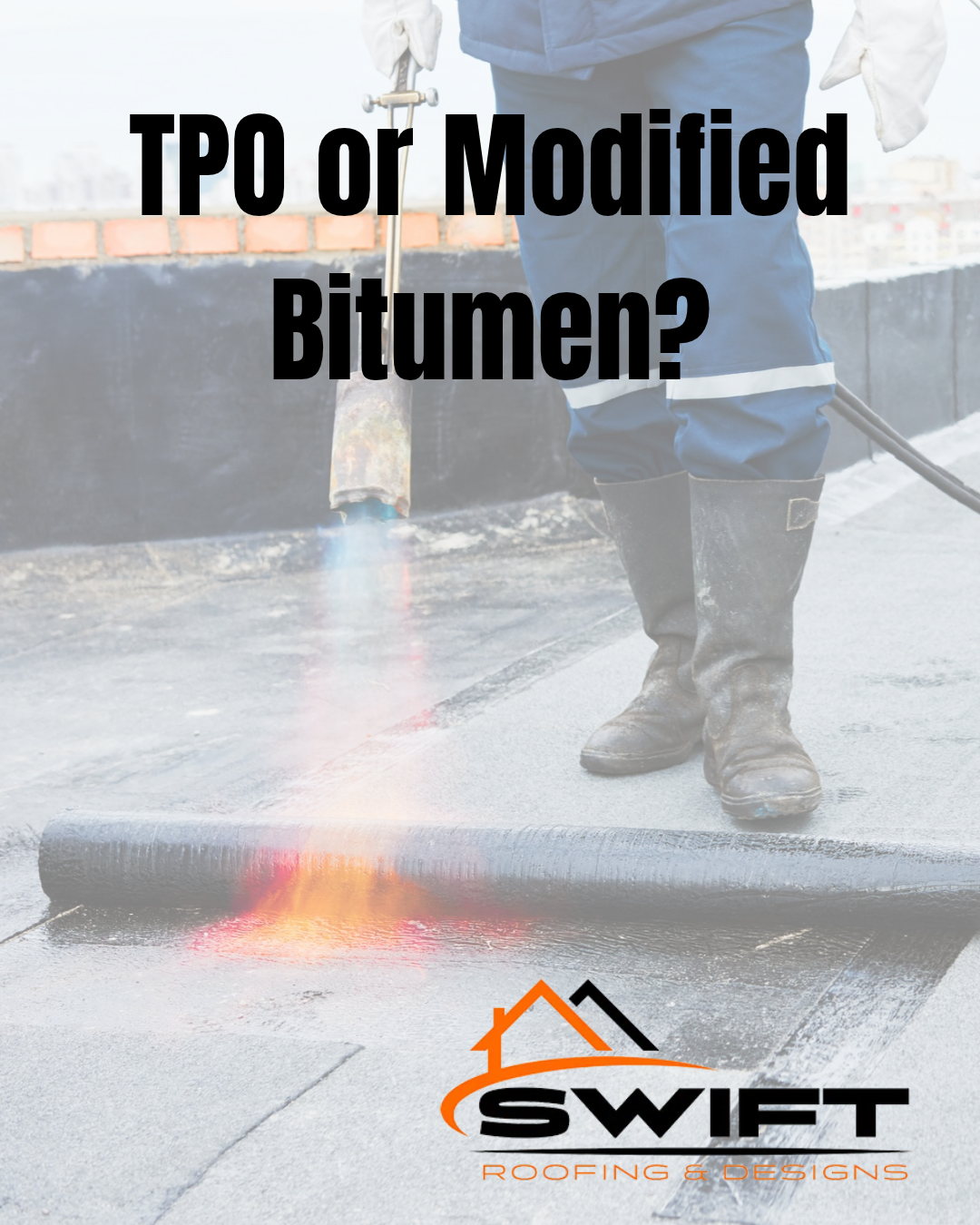

Choosing the best material for a flat roof requires more than comparing membrane names. A commercial roof must manage heat, wind, rain, drainage, rooftop equipment, maintenance traffic, and the consequences of a leak inside the building. TPO and modified bitumen can both protect low-slope properties in North Texas, but they use different materials and installation strategies. The right choice depends on the building, roof deck, operations, budget, and performance priorities.


TPO is a thermoplastic single-ply membrane known for heat-welded seams and commonly available reflective surfaces. Modified bitumen is an asphalt-based membrane reinforced with polyester, fiberglass, or composite material and often installed as a multi-ply system. One is not automatically modern and better, while the other is not automatically stronger in every application. This TPO vs modified bitumen guide explains how property owners in Royse City and nearby communities can compare the complete systems rather than relying on a single selling point.

The Roof Assembly Matters More Than the Membrane Name

TPO or modified bitumen is only the top portion of a commercial roofing assembly. Below it may be a roof deck, vapor retarder, insulation, cover board, fasteners, adhesives, and other components selected for the building. Drains, scuppers, penetrations, parapets, edge metal, curbs, and expansion joints also affect performance. A premium membrane cannot overcome trapped moisture, weak decking, poor slope, or incorrect flashing.


That is why the selection process should begin with an inspection and a clear understanding of the existing roof. The contractor needs to know whether the roof can be recovered or requires tear-off, whether insulation is wet, where water ponds, how much rooftop traffic occurs, and what wind uplift requirements apply. Interior operations, fire precautions, odor sensitivity, access, and the owner’s maintenance plan can also change the recommendation. A useful proposal describes the full assembly instead of listing only “TPO” or “mod-bit.”

Compare TPO and Modified Bitumen Side by Side

TPO is supplied in membrane sheets that are joined with hot-air-welded seams. It can be mechanically attached, adhered, or installed using other manufacturer-approved methods. Modified bitumen uses asphalt modified with polymers and may be installed with cold adhesive, self-adhered sheets, hot asphalt, heat welding, or torch application depending on the specified product.

Decision factor TPO roofing Modified bitumen roofing
System type Thermoplastic single-ply membrane Reinforced asphalt-based membrane, often multi-ply
Seam method Hot-air welded Heat-welded, self-adhered, cold-applied, or hot-applied depending on product
Surface options Commonly white or light-colored and reflective Granulated, smooth, coated, or reflective cap-sheet options
Weight Relatively lightweight Generally heavier, especially in multi-ply assemblies
Foot traffic Benefits from designated walk pads and cover-board support Multi-ply systems can be well suited to recurring service traffic
Repairs Compatible membrane patches are welded after proper preparation Compatible asphaltic patches can address localized damage
Installation concerns Weld quality, membrane thickness, attachment, and detailing Ply count, adhesion, laps, heat or odor controls, and detailing
Common fit Large open roof areas and reflective-roof priorities Roofs needing redundancy, robust detailing, or frequent access

This comparison describes common system characteristics, not guarantees. TPO products vary by thickness, reinforcement, formulation, attachment, cover board, and warranty. Modified bitumen systems vary by SBS or APP formulation, reinforcement, ply count, surfacing, and application method. Property owners should compare named assemblies and manufacturer-approved specifications, not generic material labels.


Swift Roofing & Designs installs both systems as part of our commercial roofing services. That allows the recommendation to follow the roof instead of forcing every building into one material. The inspection should explain what each proposed assembly includes and why it fits the property.

Where TPO Roofing Has an Advantage

TPO is often attractive for broad, open roof areas where a light-colored membrane and efficient installation support the project goals. Because it is thermoplastic, overlapping sheets can be joined with hot air to form welded seams. GAF’s overview of single-ply roof membranes notes that TPO may be mechanically attached, adhered, or induction-welded and that its seams are heat-welded. The completed system is relatively light and can cover substantial commercial roof areas without the multiple membrane plies used in many asphaltic assemblies.


TPO still depends on workmanship and system design. Weld temperature, equipment settings, membrane preparation, weather, sheet alignment, and detail work can affect seam quality. Thickness alone does not determine performance because reinforcement, formulation, insulation, cover board, drainage, attachment, and maintenance all matter. A reflective membrane is useful only when the complete roof is correctly designed and installed.

Where Modified Bitumen Roofing Has an Advantage

Modified bitumen combines asphalt with polymers to improve performance and uses reinforcement to support strength and flexibility. Many assemblies use more than one layer, creating redundancy that appeals to owners concerned about punctures, rooftop traffic, and complex flashing details. Johns Manville describes SBS modified bitumen systems as available with glass, polyester, or composite reinforcement and multiple application methods, including cold-applied, heat-welded, self-adhered, mechanically fastened, and hot-applied options. That range gives designers and contractors flexibility when building access or operations limit a particular installation method.


The tradeoff is that modified bitumen systems can be heavier and more labor-intensive than a single-ply membrane. Application method matters because torch, hot-asphalt, cold-adhesive, and self-adhered work create different safety, odor, scheduling, and substrate requirements. A dark granulated surface can absorb substantial heat, although reflective cap sheets and coatings are available. Owners should compare the specified system rather than assuming every modified bitumen roof is dark, torch-applied, or identical.

North Texas Heat Makes Reflectivity Important, but Not Sufficient

White TPO is commonly selected for its solar reflectance and ability to limit heat absorbed at the roof surface. This can support a cool-roof strategy on commercial buildings in Royse City, Rockwall, Fate, and Greenville. However, reflectivity can change as the surface becomes dirty or ages, and energy performance depends on the whole building rather than membrane color alone.


Evaluate these heat-related factors:

  • Membrane or cap-sheet reflectance: Review current product data instead of relying only on color.
  • Roof insulation: Confirm type, thickness, condition, and required thermal value.
  • Air and vapor control: Consider how the assembly manages indoor and outdoor moisture conditions.
  • Rooftop equipment: Assess hot exhaust, grease, chemicals, and concentrated heat near the membrane.
  • Drainage: Ponding water can increase stress and collect dirt regardless of surface color.
  • Maintenance: Cleaning and inspection practices affect long-term surface condition.


Modified bitumen can also support reflective-roof goals when specified with a reflective cap sheet or compatible coating. TPO may offer a straightforward reflective surface, but it should not be described as an automatic solution to high cooling bills. HVAC efficiency, insulation, air leakage, interior use, operating hours, and roof-to-wall conditions all influence energy consumption.

Roof Traffic, Repairs, and Building Operations Can Shift the Choice

A warehouse with limited roof access has different needs from a retail center where technicians regularly service HVAC units. TPO can perform well when walk pads, a suitable cover board, and controlled access protect traffic routes. Modified bitumen’s reinforced and often multi-ply construction can be appealing where the roof experiences repeated service activity or where redundancy is a major priority. Neither membrane should be treated as a walking surface without protection and maintenance planning.


Repairability also depends on age, contamination, access, and the technician’s ability to identify the existing system. TPO repairs typically use compatible membrane and hot-air welding after careful cleaning and preparation, while modified bitumen can often be patched with compatible asphaltic materials. Food operations, occupied offices, schools, churches, and medical uses may restrict odors, open flame, noise, or shutdowns during installation. The best roof is one the building can safely install, inspect, maintain, and repair.

Drainage, Wind Design, and Details Decide Real Performance

Flat roofs are not truly flat. They need positive drainage toward internal drains, scuppers, or gutters, and areas of persistent ponding deserve investigation before a new membrane is installed. Adding a new surface without correcting low areas, blocked outlets, or inadequate drainage can preserve the original problem beneath a new roof.


The design should address:

  • Existing deck type, condition, attachment capacity, and localized deterioration.
  • Tapered insulation or crickets needed to improve drainage around curbs and parapets.
  • Wind-uplift design for the field, perimeter, and corner zones of the roof.
  • Edge metal, parapet transitions, termination bars, and flashing heights.
  • Equipment curbs, pipes, drains, scuppers, skylights, and other penetrations.
  • Cover-board needs for hail, foot traffic, and substrate protection.
  • Expansion joints and movement between different building sections.
  • Tear-off limits, moisture testing, and code or manufacturer requirements.


North Texas wind and storm exposure should be addressed through an approved assembly, not a generic promise that one membrane “handles storms better.” Attachment patterns, adhesives, fasteners, edge systems, deck conditions, and tested assemblies affect uplift resistance. Hail performance also involves membrane thickness, reinforcement, substrate hardness, cover board, age, and impact severity.


Visual inspection may not reveal all moisture trapped inside an existing commercial roof. Swift’s guide to infrared vs visual roof inspections explains how the methods answer different questions when investigating low-slope assemblies. Appropriate testing can help define whether targeted replacement, a recover, or broader tear-off deserves consideration.

Use a Decision Framework and Compare Complete Project Costs

The decision should begin with property conditions and business consequences. A building owner who prioritizes a reflective surface and efficient coverage of a large open roof may lean toward TPO. An owner who prioritizes multi-ply redundancy, familiar asphaltic repairs, or regular rooftop service access may lean toward modified bitumen.


Use this decision framework:

  1. Document the existing assembly. Identify membrane, deck, insulation, wet areas, repairs, and remaining useful components.
  2. Define operational limits. Record odor, flame, noise, access, scheduling, and tenant restrictions.
  3. Set performance priorities. Rank reflectivity, redundancy, traffic tolerance, wind design, drainage, warranty, and repair access.
  4. Compare complete assemblies. Review membrane, thickness, ply count, insulation, cover board, attachment, flashing, and edge details.
  5. Plan maintenance. Identify inspection frequency, walk paths, drain cleaning, repair methods, and documentation responsibilities.
  6. Compare lifecycle cost. Include removal, insulation, disruption, maintenance, energy goals, repairs, and future replacement, not only membrane price.
Building condition or priority System that may fit better What must be verified
Large open roof with reflective-surface goals TPO often fits well Insulation, attachment, seam quality, drainage, and rooftop contaminants
Frequent service traffic or puncture concern Modified bitumen may fit well Ply count, reinforcement, walk paths, cover board, and repair plan
Strict odor or open-flame limits TPO or self-adhered/cold-applied mod-bit Approved installation method and building operating plan
Complex details and many penetrations Either with a strong detail design Manufacturer details, flashing transitions, and installer experience
Existing compatible asphaltic assembly Modified bitumen may simplify integration Moisture condition, adhesion, code, and recover eligibility
Lightweight assembly is important TPO may have an advantage Deck capacity and complete assembly weight

What Do TPO and Modified Bitumen Roofs Cost?

Every commercial roof we estimate is priced around the actual building, roof assembly, and project requirements because the membrane is only one part of the scope. For general planning, Fixr’s 2026 flat-roof material guide lists TPO at approximately $4 to $13 per square foot installed and modified bitumen at approximately $4 to $6 per square foot installed. These are independent national market ranges, not our pricing or a North Texas project quote. Your final cost may change based on tear-off, insulation, deck repairs, tapered drainage, cover board, edge systems, penetrations, permits, engineering, and phased access.

Cost component TPO roofing Modified bitumen roofing
Independent installed range About $4 to $13 per square foot About $4 to $6 per square foot
Membrane variables Thickness, reinforcement, attachment, and sheet type SBS or APP, reinforcement, surfacing, application, and ply count
Assembly variables Insulation, cover board, fasteners, adhesives, and edge system Base sheets, insulation, cover board, adhesives, cap sheets, and edge system
Operational variables Welding access, staging, equipment movement, and phasing Heat, odor, staging, material handling, and phasing
Common unknowns Wet insulation, deck repairs, drainage corrections, and penetrations Wet insulation, deck repairs, drainage corrections, and penetrations

When comparing proposals, review each scope line by line instead of relying only on the total price. One estimate may include complete tear-off, code-required insulation, tapered crickets, cover board, and new edge metal, while another may cover only the surface membrane. We also offer commercial roofing financing options, but we recommend confirming the complete scope and specifications before evaluating financing. That gives you a clearer understanding of what the project includes and makes competing proposals easier to compare.

Frequently Asked Questions

  • Is TPO Better Than Modified Bitumen for Texas Heat?

    White TPO often provides a straightforward reflective surface that can support a cool-roof strategy. Modified bitumen can also use reflective cap sheets or compatible coatings. Insulation, air leakage, HVAC operation, roof cleanliness, and interior use influence energy performance. Compare complete assemblies instead of judging only by membrane color.

  • Which System Handles Hail Better?

    Neither system is hail-proof. Performance depends on membrane thickness, reinforcement, age, substrate, cover board, assembly design, and hail severity. Modified bitumen’s multi-ply configurations may provide redundancy, while a TPO assembly can add a suitable cover board for support. Ask how the exact proposed assembly addresses impact exposure and repairs.

  • Is Modified Bitumen Always Torch-Applied?

    No. Modified bitumen products may be torch-applied, heat-welded, hot-applied, cold-adhered, self-adhered, or mechanically fastened depending on the system. The installation method must match the product, substrate, building operations, and safety requirements. A contractor should identify the method in the proposal.

  • Can TPO Be Installed Over an Existing Modified Bitumen Roof?

    Sometimes, but compatibility, moisture, attachment, surface condition, code, warranty, and manufacturer requirements must be evaluated. Thermoplastic membranes and asphaltic materials may require an approved separator or cover board. Wet insulation or damaged decking should not be trapped beneath a recover system. Inspection and testing should determine whether recover or tear-off is appropriate.

  • Which Flat Roof Is Easier to Repair?

    Both can be repairable when technicians correctly identify the system and use compatible materials. TPO typically uses cleaned and prepared membrane patches that are hot-air welded. Modified bitumen commonly uses compatible asphaltic patches or membranes. Age, contamination, access, damage location, and prior repairs can make either system more difficult.

  • How Often Should a Commercial Flat Roof Be Inspected?

    Most commercial roofs benefit from scheduled inspections at least twice a year and after significant storms, although the manufacturer, warranty, insurer, and building conditions may require a different plan. Drains, seams, flashings, penetrations, edge metal, and traffic areas deserve particular attention. Keep photographs, repair records, and maintenance reports together. Early documentation makes changes easier to track before a leak disrupts operations.

Select the System That Fits the Building and Its Operations

TPO can be an excellent choice for a property that values a reflective single-ply membrane, lighter assembly, heat-welded seams, and efficient coverage of broad roof areas. Modified bitumen can be an excellent choice where the owner values asphaltic compatibility, multi-ply redundancy, robust detailing, and repair methods familiar to many commercial roofing teams. Neither answer should be selected from climate or cost alone. The best commercial flat roof is the complete assembly designed for the building, installed correctly, and maintained consistently.


If you manage a commercial or low-slope property in Royse City, Rockwall, Fate, or Greenville, contact Swift Roofing & Designs for a roof-specific evaluation. We can document existing conditions, explain whether TPO or modified bitumen better fits the property, and identify the insulation, drainage, attachment, and detail work the project requires. A clear proposal should show the entire assembly and define how the work will be coordinated around the building. That gives owners a decision based on performance, risk, and lifecycle value instead of a generic material preference.


Commercial Roofing Services

Infrared vs Visual Commercial Roof Inspections

Commercial Roofing Financing

Contact Swift Roofing & Designs


Request a Roofing Quote

Blog Form


More Posts Like This:

Large white building in a grassy field with a ladder against it and a few people nearby.
October 12, 2026
Learn how long a TPO roof lasts in Texas, which factors shorten its service life, and when commercial property owners should repair or replace it in 2026.
Green two-story house with white garage, concrete driveway, and lawn chairs under a blue sky
October 5, 2026
Use this North Texas fall roof inspection checklist to check shingles, flashing, valleys, vents, drainage, and attic clues before cooler weather arrives.
Roof work area with yellow caution tape, traffic cone, tools, and a ladder by the edge of a building
September 28, 2026
Learn why vent pipe boots fail after North Texas heat, how to spot a roof vent leak, what repairs involve, and when Royse City homeowners should act now.
Show More
Black outline of a house with a slanted roof and chimney.

Choose Swift Roofing & Designs for Top Quality Roofing

Need a reliable roofer? We've helped countless clients protect their homes while saving time and money, and we’re ready to help you next.

Large white building in a grassy field with a ladder against it and a few people nearby.
October 12, 2026
Learn how long a TPO roof lasts in Texas, which factors shorten its service life, and when commercial property owners should repair or replace it in 2026.
Green two-story house with white garage, concrete driveway, and lawn chairs under a blue sky
October 5, 2026
Use this North Texas fall roof inspection checklist to check shingles, flashing, valleys, vents, drainage, and attic clues before cooler weather arrives.
Roof work area with yellow caution tape, traffic cone, tools, and a ladder by the edge of a building
September 28, 2026
Learn why vent pipe boots fail after North Texas heat, how to spot a roof vent leak, what repairs involve, and when Royse City homeowners should act now.
Aerial view of a house with a dark gray roof surrounded by green trees and lawn.
September 21, 2026
Compare roof maintenance vs roof repair for Royse City homes, spot warning signs, understand costs, and prepare your roof before North Texas fall rain.
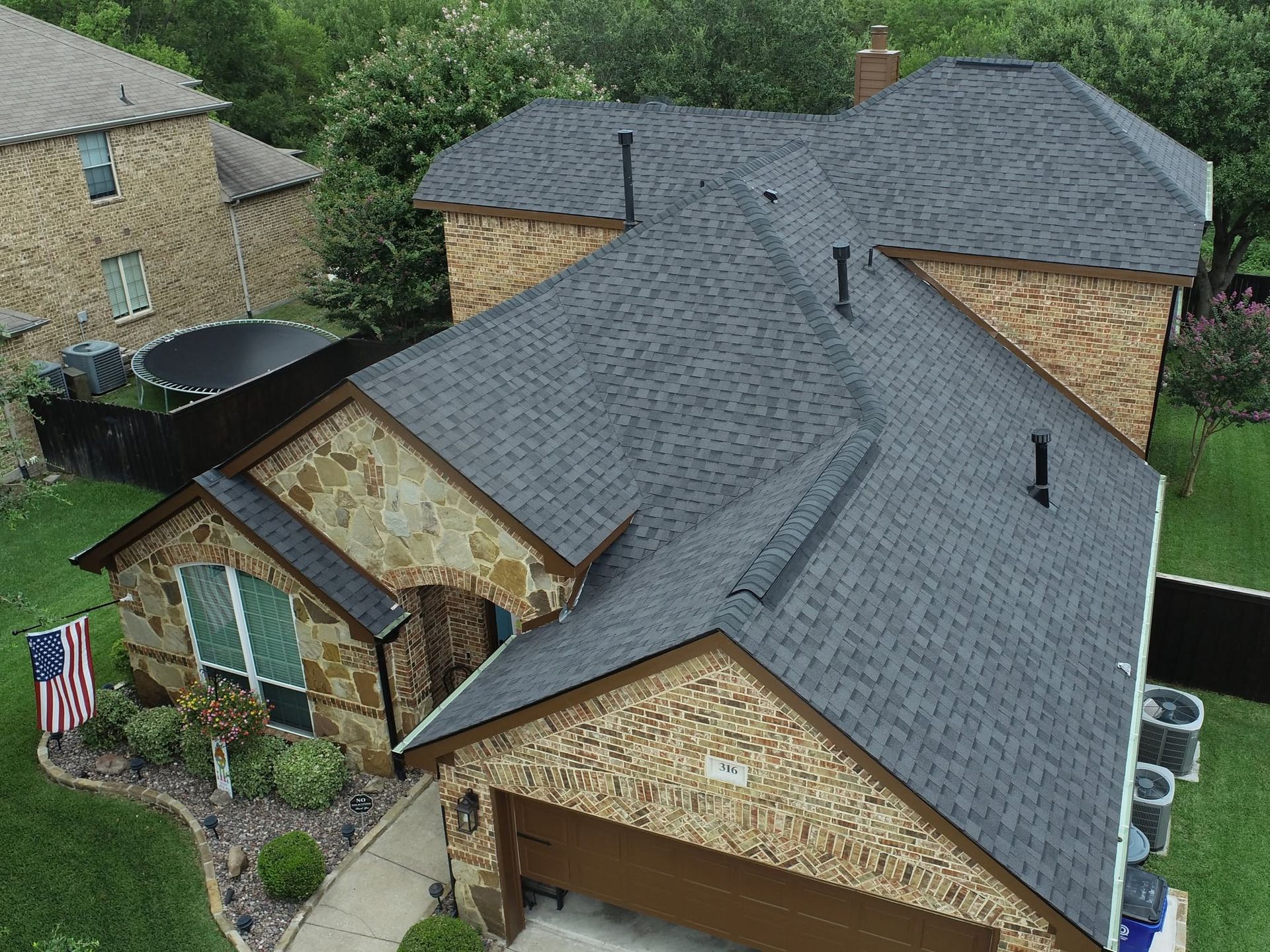
Aerial view of a suburban brick house with a dark gray roof and American flag by the front yard
September 14, 2026
Learn 5 reasons black streaks or roof discoloration appear after a North Texas summer, when stains are cosmetic, and when damaged shingles need repair.
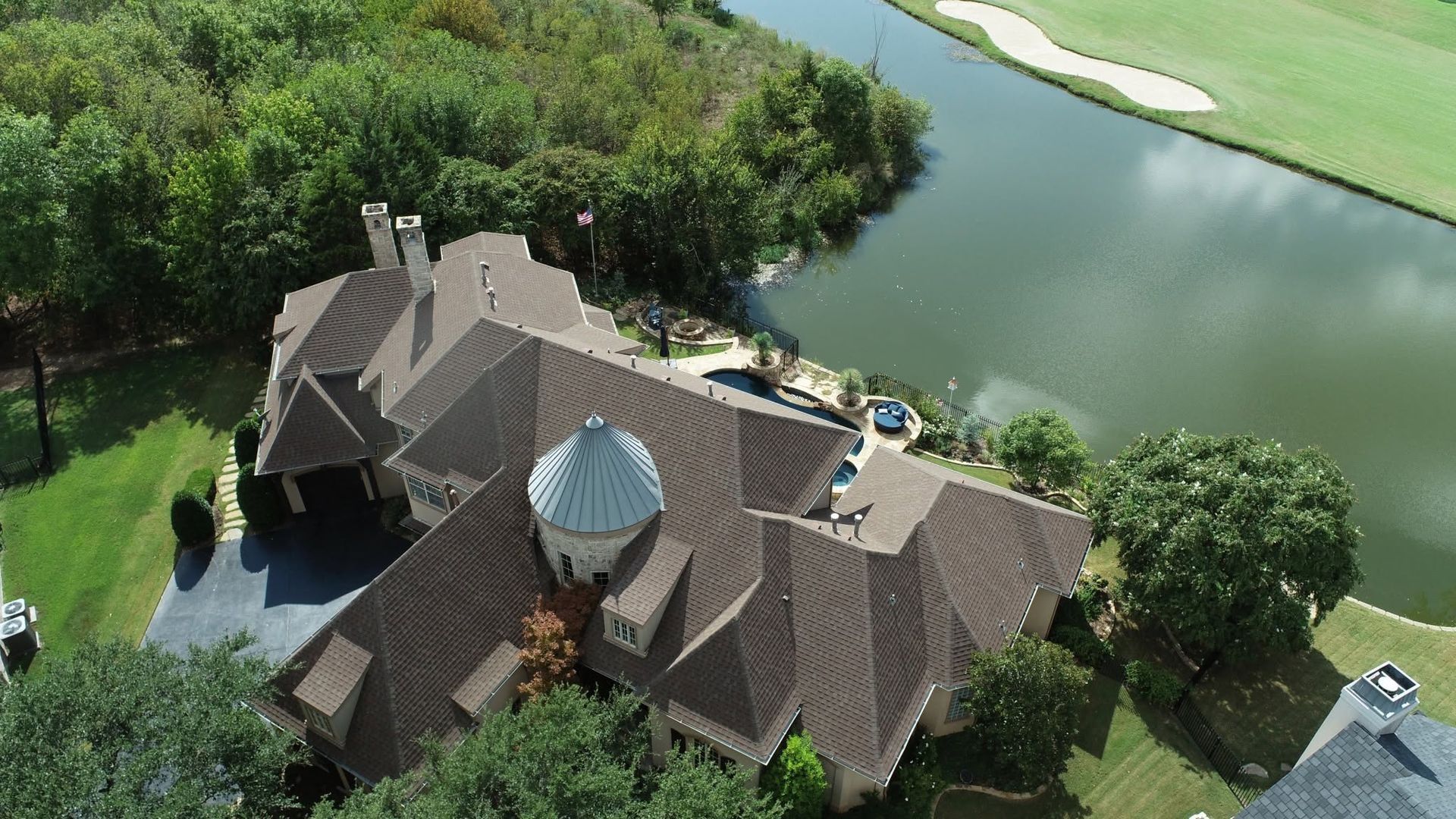
Aerial view of a large house with a dome roof beside a lake, surrounded by trees and greenery.
September 7, 2026
Learn why a roof leaks only during heavy rain in North Texas, what wind-driven rain reveals, what to check, and when expert roof leak repair is needed.
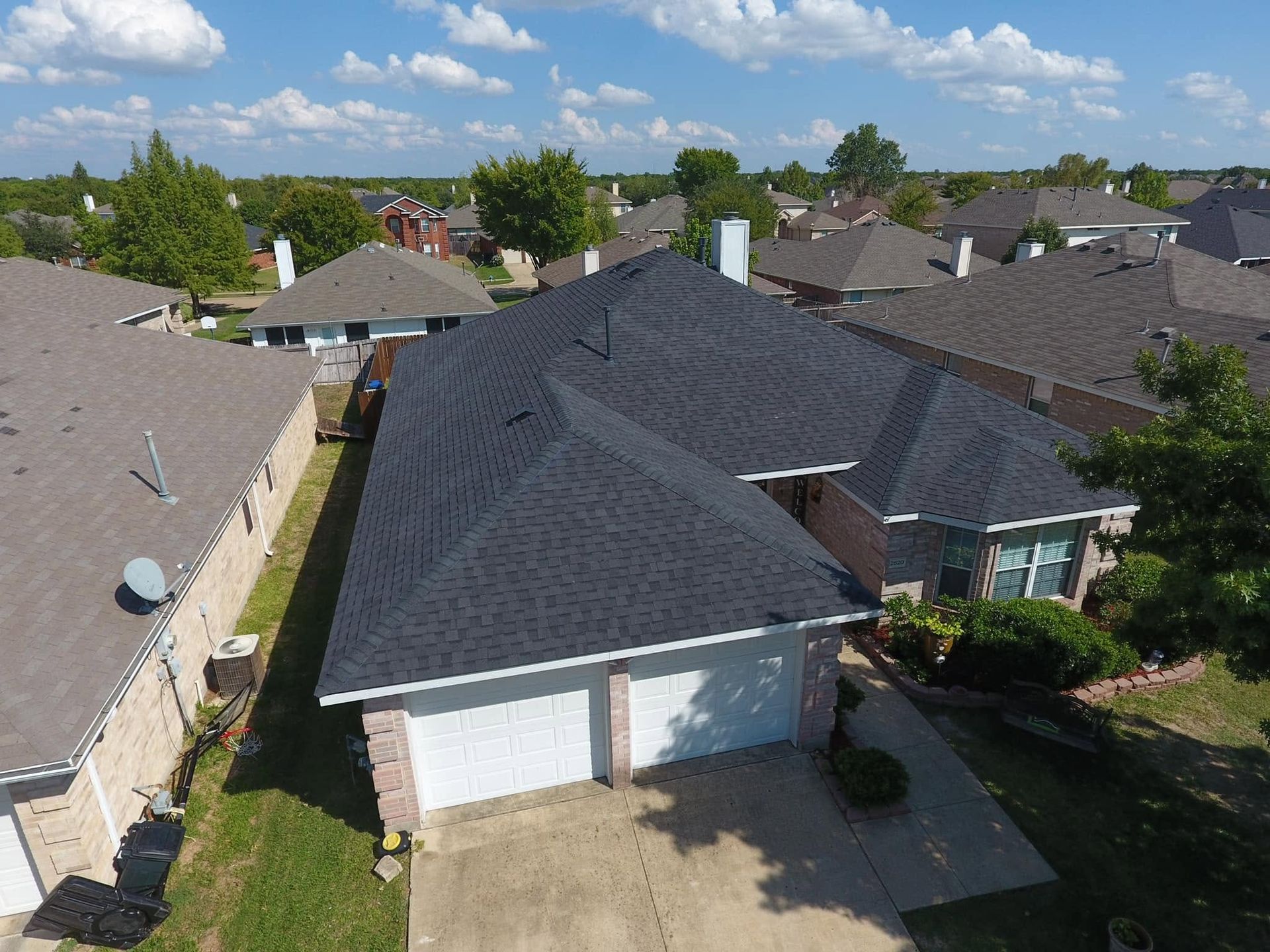
Aerial view of a suburban house with a dark roof and white garage under a blue sky
August 31, 2026
Compare roof restoration vs replacement before winter in North Texas with real inspection checks, cost factors, and September 2026 planning tips.
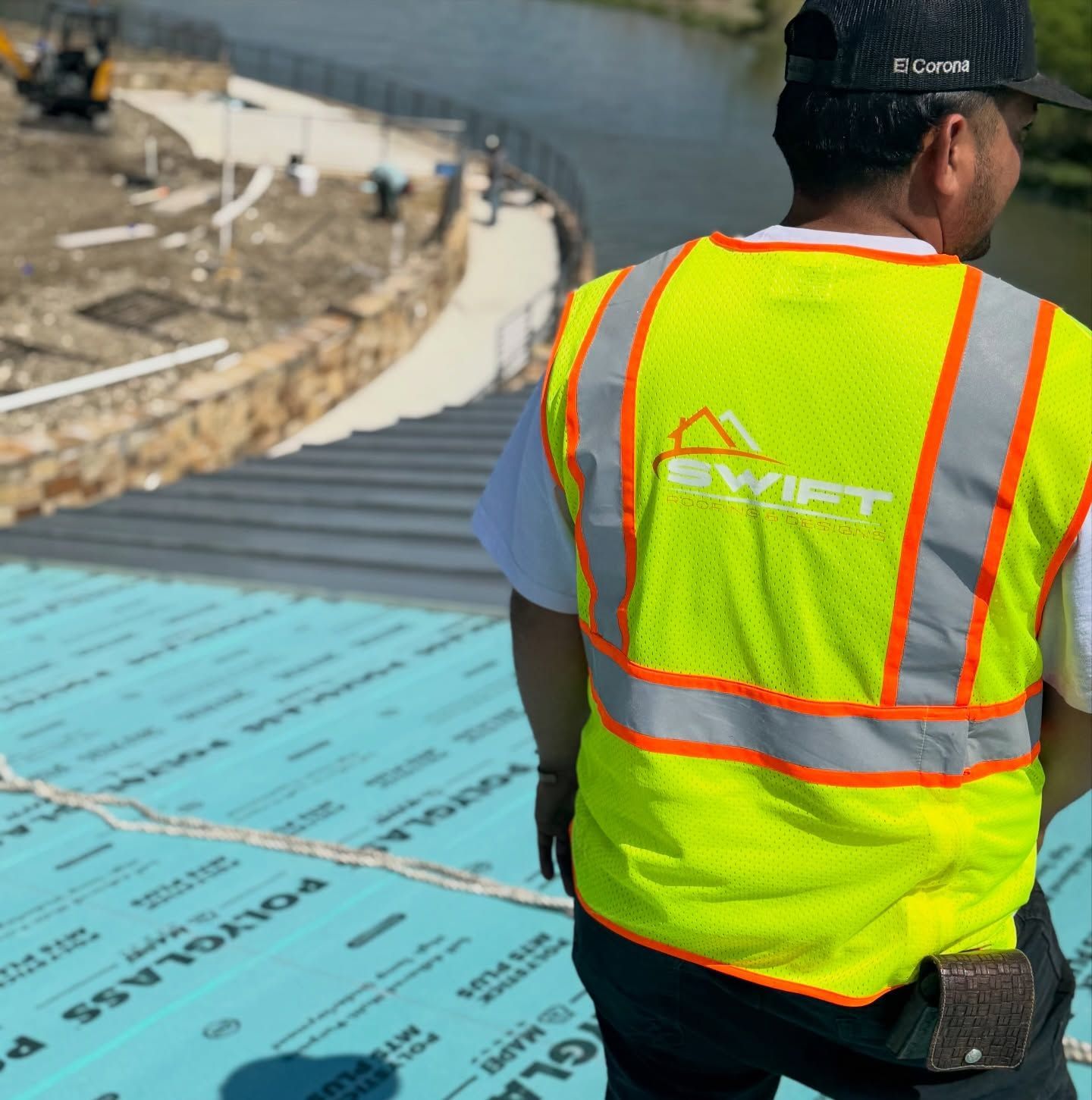
Worker in neon safety vest stands on a roof beside a curved waterfront walkway.
August 24, 2026
See 4 roof inspection findings Royse City homeowners should address before hail, wind, heat, and rain turn small defects into larger repairs.
Roofing crew installing plywood sheathing on a large flat roof under construction
August 17, 2026
Learn why August thunderstorms can turn minor roof damage into emergencies and when to call for emergency roof repair in Royse City, TX.
Aerial view of a roof under repair with black tarps, workers, and scattered equipment around the house.
August 10, 2026
Learn when to file a hail damage roof claim or pay out of pocket based on your deductible, policy type, and damage scope in North Texas.
Show More